 In 2013 a global brute-force attack began hitting WordPress installations on virtually every WP host server in existence around the world.
These attacks were caused by computer networks infected with viruses and programmed to attack other vulnerable computers (botnets).
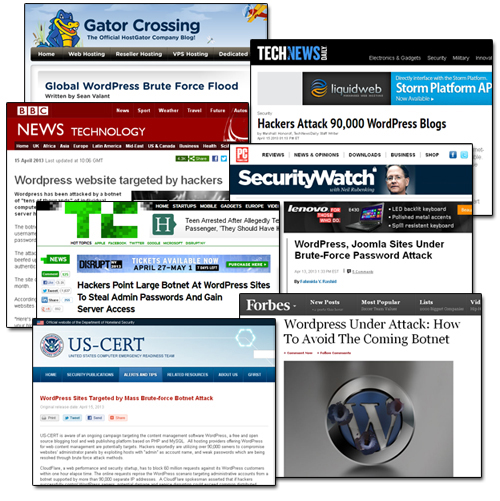
(WordPress is the world’s most used CMS which makes it an obvious target for malicious attempts by hackers)
On March 11, 2014, many leading technology sites began reporting that 160,000+ legitimate WordPress-powered websites had been hacked.
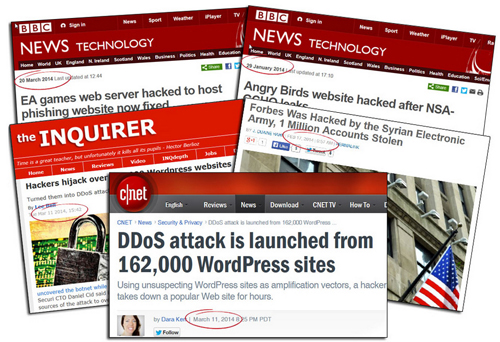
(160,000+ WordPress sites were attacked in a massive DDoS attack in March 2014. Screenshot image: BlogDefender site)
According to the Cnet report,
“With some old-fashioned trickery, hackers were able to get more than 162,000 legitimate WordPress-powered Web sites to mount a distributed-denial-of-service attack against another Web site.”
(Source: cnet.com/news/ddos-attack-is-launched-from-162000-wordpress-sites)
As described by security firm Sucuri, hackers had leveraged a well-known flaw to attack unsuspecting WP websites and direct a distributed-denial-of-service cyber attack (DDoS) towards another popular website.
Whenever attacks on WordPress sites increase in frequency, it’s natural for people to start questioning if WordPress really is a secure software for building and running websites.
Being the world’s most popular content management system makes WordPress a target for hacking. But should you be concerned about WordPress as a secure web platform?
In this article, you will learn some of the main reasons why you should choose WordPress if you are concerned about website security.
WordPress Security Explained
Let’s start with some facts …
Thousands of websites and blogs are attacked every year … not just WordPress sites!
The sheer number of attacks on websites and blogs worldwide is increasing on a daily basis, and it’s only going to get worse.
You can safely assume that if your website or blog hasn’t been hacked yet, then it’s inevitable that at some point in time someone will attempt to hack into your site … regardless of the web platform your website has been built with!
Since it’s not a matter of if, but when before your website is targeted by hackers, are there any advantages that WordPress can offer you in terms of security?
Is “Open Source” Software Safe?
Many people argue that WordPress should not be used for running a web presence because it’s “open source” and freely available application.
Open-source CMS programs like WordPress, Drupal and Joomla are free to use and anyone has access to the software code.
The argument, then, goes something like this: If everyone can access the Open Source code for WordPress, then hackers can easily obtain the code and go through every single line, searching for vulnerabilities that could be exploited …

(It’s not a matter of if, but when before someone will attempt to hack your website … WordPress or no WordPress!)
While it’s true that WordPress is a free program and hackers can easily go through the code searching for weaknesses and vulnerabilities they can exploit (hackers can do the same with any software program), the fact that WordPress is a free, open-source software platform actually makes it a whole lot more secure in many ways.
The reason for this is that WordPress is supported by a huge volunteer community that consists of thousands of people such as software programmers, plugin developers and theme designers who are constantly working to help improve the software and make WordPress more secure …
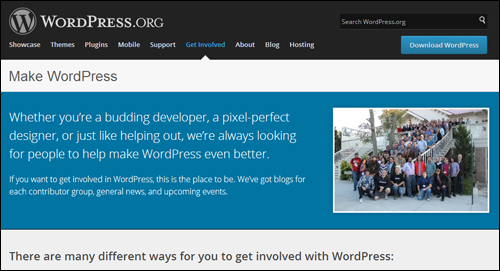
(WordPress is built, maintained and updated by a global community of developers. Screenshot image: make.wordpress.org)
WordPress continually evolves because of the effort of a huge community working around the clock to fix any issues detected by users. Everyone benefits from thousands of individuals dedicated to improving the application, fixing bugs and making the WordPress platform safer for every user …
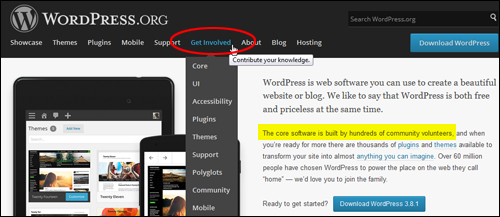
(WordPress is built by an open community of volunteers. Screenshot source: WordPress.org)
As soon as a security vulnerability is identified by developers or users, the WordPress developers are then notified …
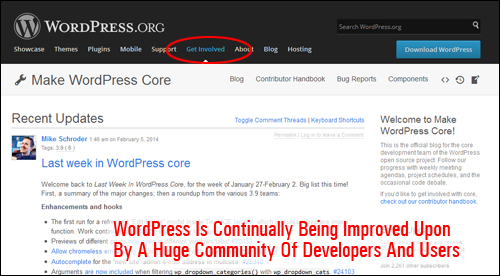
(WordPress is continually being improved upon by thousands of committed individuals community of web developers and users. Screenshot image: WordPress.org)
The WordPress community support system is very responsive and anybody can contribute to the process of getting vulnerabilities plugged.
For example:
- If you find bugs or security holes, you can report these by emailing security@wordpress.org.
- If you find issues in a WordPress plugin, you can also report these by sending an email to plugins@wordpress.org.
This is the reason why the WordPress team releases new version updates so frequently, and why you need to keep your site regularly maintained …
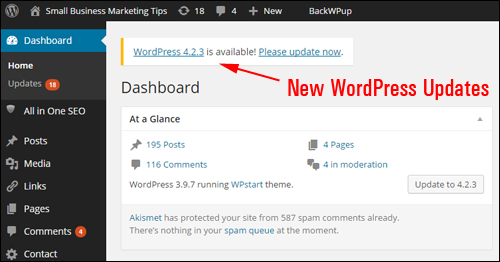
(WordPress frequently releases new updates to plug security issues)
WordPress CMS Vs Proprietary Platforms
We’ve just seen that one of the security advantages of using an open source technology like WordPress is that users benefit from a large community of developers who continually contribute to improve platform security. By contrast, a proprietary or “closed-source” CMS platform is normally built by a small team of developers with limited time and resources to provide continuous security monitoring, maintenance services, bug fixes and updates.
WordPress is free to download, use and modify, and thousands of volunteers and expert developers are continually working to improve the technology. Can a proprietary technology company afford to employ as many developers and programmers and still deliver users software that is 100% free to download, use and modify as they wish?
WordPress CMS Vs Other Open Source Applications
(CMS Platforms)
Whilst on the topic of Open Source content management systems, research shows that WordPress is actually safer than other leading Open Source CMS platforms such as Drupal and Joomla.
For example, the chart below shows how many security vulnerabilities were discovered in each of these open source CMS platforms …
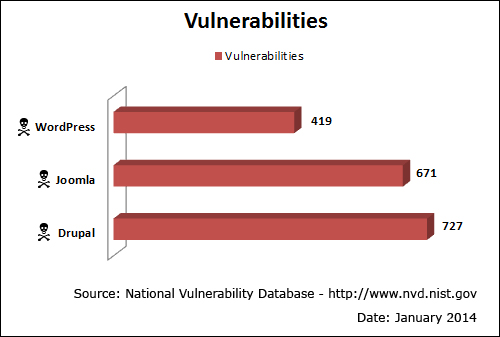
(WordPress experiences fewer security vulnerabilities than other leading CMS platforms. Source: National Vulnerability Database)
Other research indicates that, because WordPress is easy to use and maintain, when sites across different CMS platforms were tested for security vulnerabilities, WordPress sites had fewer exposure to risk …
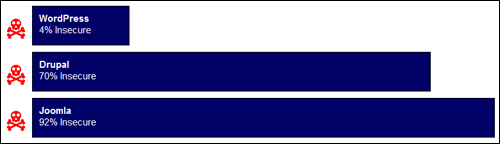
(WordPress is more secure than other CMS applications. Screenshot image: BlogDefender.com)
Don’t Blame The WordPress CMS
If someone hacks into your WordPress site, don’t be quick to place the blame on the WordPress CMS platform.
According to security vendor Commtouch and StopBadware, a nonprofit organization that helps webmasters identify, remediate and prevent website compromises in a published report entitled “Compromised Websites: An Owner’s Perspective“, most website owners are not fully aware of the threats their websites are exposed to, how to properly secure a website, or deal with compromised web security.
In fact, 63% of webmasters surveyed for the report didn’t know how their sites were compromised after an attack …
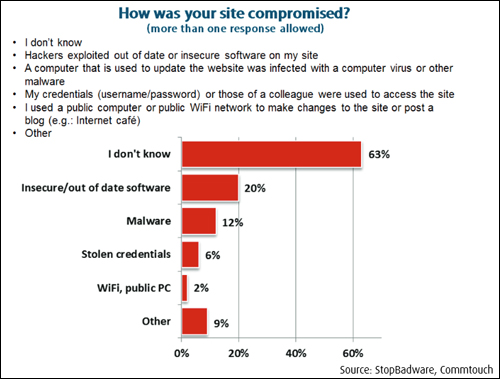
(Many webmasters don’t know how their sites get hacked. Screenshot source: StopBadware.org)
Of more immediate concern, however, is the fact that most security-related issues come from site owners forgetting to upgrade their WordPress software to the latest version …
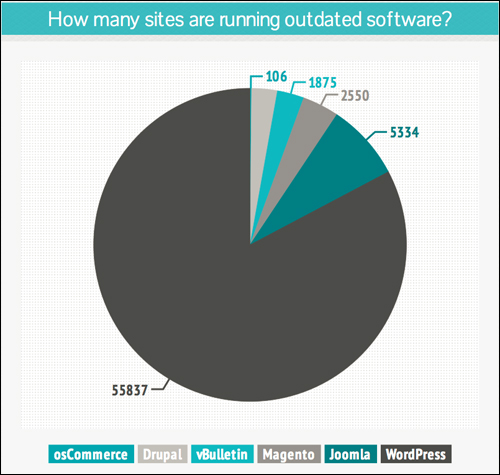
(Many security issues come from sites running outdated WordPress versions. Image source: Sucuri.net)
When WordPress security issues were looked at in more detail, it was found that only between 25% – 30% percent of vulnerabilities discovered in 3rd-party code are found in the WordPress core software, while most security issues are found in plug-ins and developed externally for WordPress …
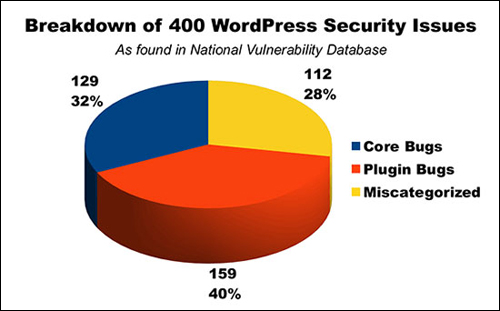
(WordPress Security Issues. Source: WebDesign.org)
Like many software applications, WordPress is updated regularly to deal with new security vulnerabilities that can arise. Improving security is an ongoing concern, and to that end, you should always keep your WordPress software, themes, and plugins up-to-date.
WordPress … Secure Enough For Banks To Use!
The amount of misinformation online about how secure WordPress is has even caused Matt Mullenweg, the co-founder of WordPress, to chime in and reply to posts online.
In an article entitled “A Bank Website on WordPress” published on April 15, 2015, Matt wrote the following about WordPress security …
There’s a thread on Quora asking “I am powering a bank’s website using WordPress. What security measures should I take?” The answers have mostly been ignorant junk along the lines of “Oh NOES WP is INSECURE! let me take my money out of that bank”, so I wrote one myself, which I’ve copied below.
I agree there’s probably not a ton of benefit to having the online banking / billpay / etc portion of a bank’s website on WordPress, however there is no reason you couldn’t run the front-end and marketing side of the site on WordPress, and in fact you’d be leveraging WordPress’ strength as a content management platform that is flexible, customizable, and easy to update and maintain.
Matt then goes on to provide a couple of security tips, before stating the following …
For an example of a beautiful, responsive banking website built on WordPress, check out Gateway Bank of Mesa AZ. WordPress is also trusted to run sites for some of the largest and most security-conscious organizations in the world, including Facebook, SAP, Glenn Greenwald’s The Intercept, eBay, McAfee, Sophos, GNOME, Mozilla, MIT, Reuters, CNN, Google Ventures, NASA, and literally hundreds more.
As the most widely used CMS in the world, many people use and deploy the open source version of WordPress in a sub-optimal and insecure way, but the same could be said of Linux, Apache, MySQL, Node, Rails, Java, or any widely-used software. It is possible and actually not that hard to run WordPress in a way that is secure enough for a bank, government site, media site, or anything.
Millions of businesses use WordPress to build their websites, including banks, large organizations, and e-commerce sites, not just bloggers.
Other Areas Affecting Security
Other factors that can affect WP security include things such as:
- No platform is completely safe from hacking. As many as 90% of all websites across all platforms are vulnerable to being attacked, mostly due to using software that is out of date.
- The main security threat in all web platforms seems to be the users themselves. For example, many users ignore strong password security recommendations.
- Lack of constant monitoring. Security processes need regular monitoring, testing, updating and improvement.
- Webhosting setup. For example, websites on shared webhosting are only as secure as the least secure website on the hosting grid, so if someone else has a weak FTP password on your shared server, then all sites on your server can potentially become vulnerable to being hacked also.
There Is No Reason To Avoid Choosing WordPress
As this article has hopefully shown, WordPress is as secure as most of the leading web platforms being used by businesses to build their presence online. As long as you commit to implementing basic web security measures (which all website owners should do) and keep your WordPress software (and themes, plugins, etc.) regularly up-to-date, there is no reason to avoid choosing WordPress to power your website or blog.

WordPress Security – Practical Tips
To learn about ways to protect your WordPress site from brute-force attacks see this article: Protecting WordPress From Brute-Force Attacks
An unsecured blog presents hackers with a platform to launch distributed attacks, spread malware and use your website to defraud others. Blog Defender WordPress Security Plugin makes your WordPress site invisible to malicious attacks from hackers and botnets. Go here to learn more:
If you are using outdated versions of WordPress remember to back up your WordPress site files and data before updating your software to protect your site from the latest security threats. This way, if things don’t go as planned, you can always restore everything to its former state.
If you don’t want to perform manual backups, there are many WordPress plugins you can use. You can read about a WordPress backup plugin that can automate your backup process here: Back Up, Duplicate & Protect Your WP Web Sites With Backup Creator WordPress Plugin

References Used In This Article
For more information on the above, refer to the sites below:
- ITProPortal.com
- National Vulnerability Database
- BlogDefender.com
- UpAndUpStudios.com
- StopBadware.org
- Sucuri.net
- WebDesign.org
- Quora.com
- Ma.tt
Hopefully, this post has given you a better understanding of issues that can affect your website and how WordPress can help you grow your business online. To learn more about the security benefits of using WordPress for a business web site please click on links to visit our related posts section or subscribe to receive updates and notifications whenever new content is published.
***
"This is AMAZING! I had learnt about how to use WordPress previously, but this covers absolutely everything and more!! Incredible value! Thank you!" - Monique, Warrior Forum