
Being able to display tables on your content can be really handy. Tables are great for sorting and presenting data to visitors in a format that can make your information easier to understand.
WordPress provides users with a great visual editor, but there are some things that the default editor doesn’t let you do, such as giving you the option to create tables without having to learn code.
Although you can create tables manually in WordPress if you have knowledge of HTML (Hyper Text Markup Language) and CSS (Cascading Style Sheets), for most non-technical users, this is not a feasible option.
Fortunately, you can do just about anything you need done on a WordPress site with plugins, and inserting tables into your content is no exception.
In this tutorial you will learn how to easily create and add tables into your content without requiring knowledge of HTML or CSS or coding skills.
How To Create And Add Tables In WordPress Easily Without Touching Code
To add tables into your WordPress content with no coding skills required, we’ll use a FREE plugin called TablePress.
WordPress Plugin – TablePress

TablePress is a great WordPress plugin for creating, editing and managing tables in WordPress.
TablePress doesn’t require you to have any knowledge of HTML, CSS, etc. It provides a simple user interface that allows you to easily edit your table data. Tables can contain any type of data, even formulas.
An additional JavaScript library can be used to add features like pagination, sorting, filtering, and more for visitors. You can easily include the tables into your posts and pages using shortcodes and display tables using text widgets.
You can also import and export a table from/to CSV files (e.g. from Excel), HTML files, and JSON formats.
The plugin was written and developed by Tobias Bäthge and is licensed as Free Software under GNU General Public License 2 (GPL 2).
How To Use TablePress WP Plugin – Tutorial
To create and manage tables in WordPress, install and activate the TablePress plugin.
Download the plugin here:
https://wordpress.org/plugins/tablepress
Or install it from your WordPress Dashboard …
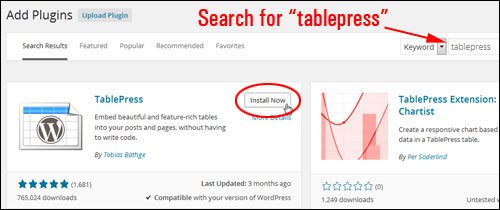
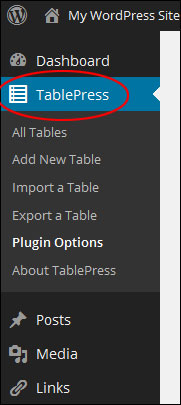
After the plugin has been installed and activated, you will see a new menu item displayed in your WP admin menu called TablePress …
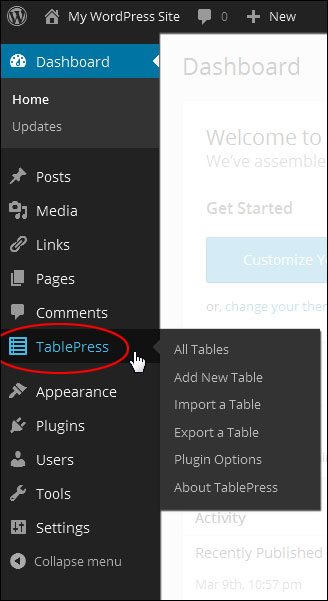
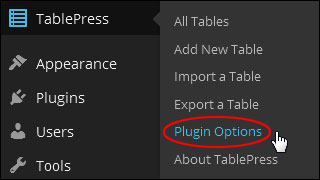
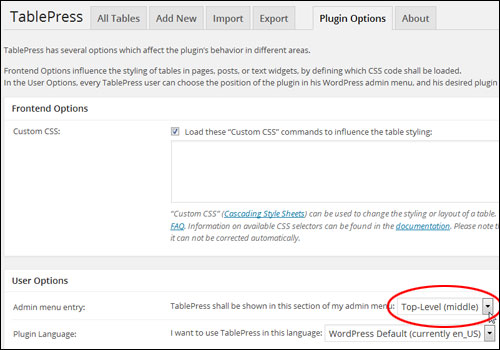
Click on TablePress and choose Plugin Options from the submenu list …
The “Plugin Options” section controls your plugin styling and display settings …
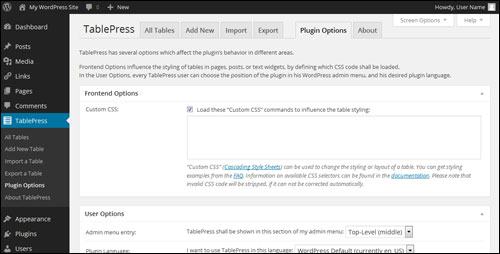
For example, in the “User Options” section, you can specify where the TablePress menu entry appears on your admin menu.
Normally, the menu item appears around the middle of your menu bar. If you plan to use this plugin a lot, then you can position the menu option closer to the top of the Dashboard menu by specifying “Top-level (middle)” on the User Options > Admin menu entry dropdown menu …
The TablePress menu item now appears closer to the top area of the admin menu …
You can also specify other plugin options in the “Plugin Options” tab, like formatting styles for your tables, default language, etc. If you don’t need to modify this section, just leave the options as the default.
With TablePress, you create edit and format your tables inside the plugin section. Tables are then inserted via a shortcode into your text. Your tables will then display when saving your page.
The great thing about doing this is that you can easily modify the information inside your tables without having to manually edit your pages and posts. The plugin then updates all of your table data inside all posts and pages where the table has been added to your content.
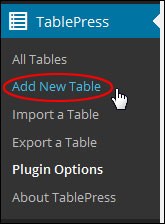
To create a new table select TablePress > Add New Table …
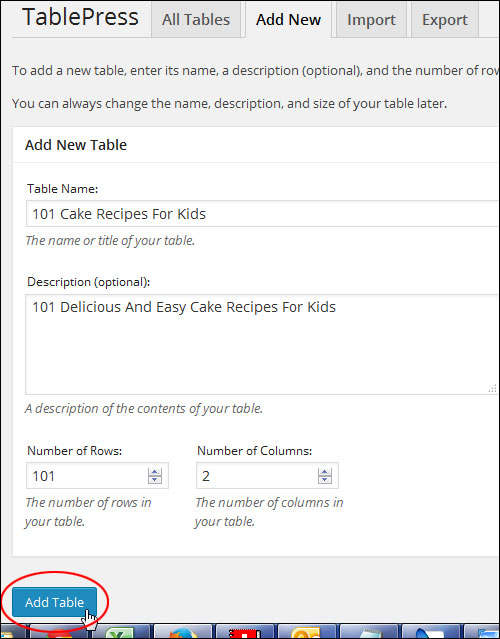
Enter a table name, an optional description, and the number of rows and columns you would like for the new table into the “Add New Table” form in the Add New tab, then click on the Add Table button to create your new table. You can edit the name, description and size of any tables you create at anytime…
Once your new table has been created, it will be listed in the “All Tables” list and be assigned a unique Shortcode ID …
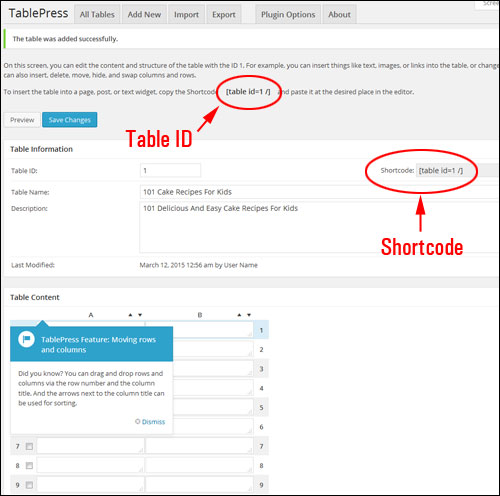
The TablePress shortcode lets you easily insert tables anywhere inside a post or page simply by typing or copying and pasting the shortcode wherever you want to display a table …
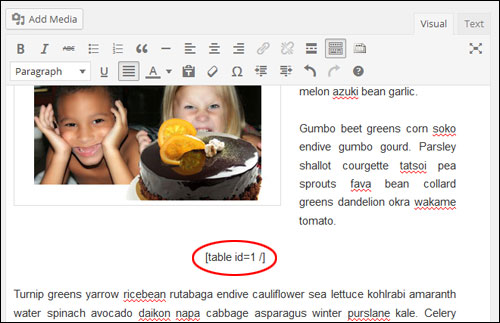
Once you have created a new table, adding content to it is easy.
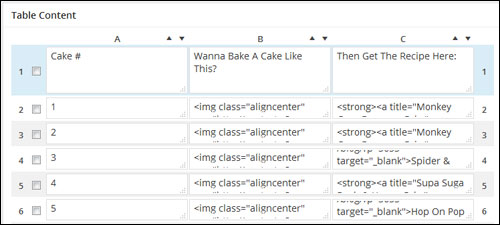
In the “Table Content” section, click in the cell and type or paste your content. You can add text, images and HTML formatting to your content (e.g. bold or italicize words, insert links, etc …)
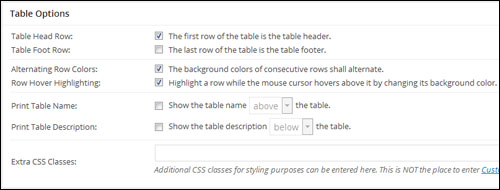
After your new table has been created, additional options appear that let you configure your table.
For example, in the “Table Options” area you can select the first row of your table to be the table header or the last row of the table to be the table footer, make the background of consecutive rows alternate in color, highlight rows when a visitor hovers their mouse over the table, print the table name and description above or below the table, and more …
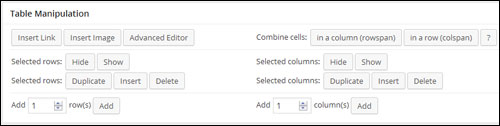
You can also modify your table after creating it in the “Table Manipulation” area. You can perform a number of table edits, such as inserting images or links, hiding, showing, inserting, deleting and cloning selected columns and rows, adding new rows and columns, combining cells, etc …
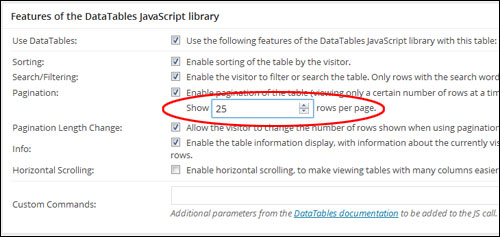
You can also enable JavaScript library features in your tables that will allow visitors to sort, filter and search your table content, set the number of table rows displayed on your page (and let visitors specify the number of rows displayed), display table information, etc …
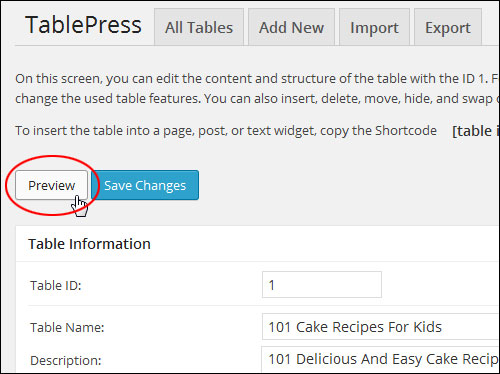
You can see how your table looks anytime, by clicking the Preview button …
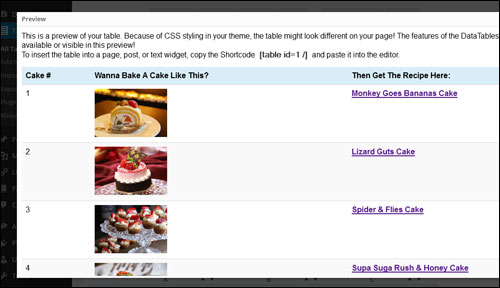
A preview window will open allowing you to preview the table. Certain features such as the JavaScript options are disabled in preview mode, but will display once your post or page is published …
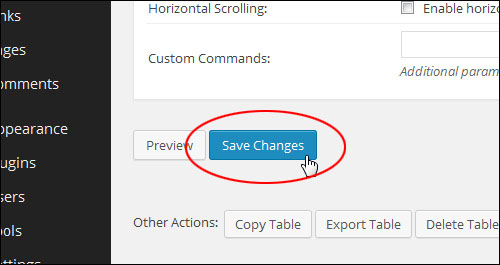
Remember to click the Save Changes button when finished to update your table data …
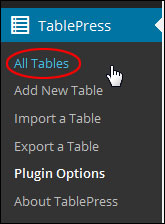
To view a list of all the tables you have created click on TablePress > All Tables …
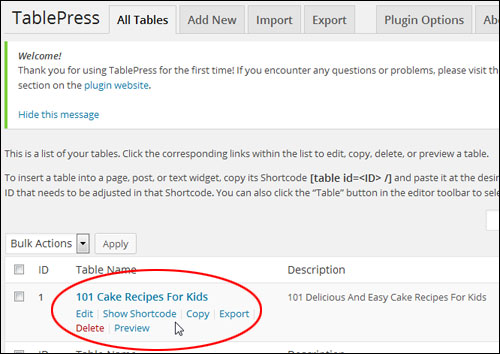
All the tables you have created are displayed in a list. You can edit, see shortcodes, copy, export, delete and preview tables …
How To Use The TablePress Shortcode To Embed Tables Into Your Content
You insert tables into any pages and posts using a shortcode.
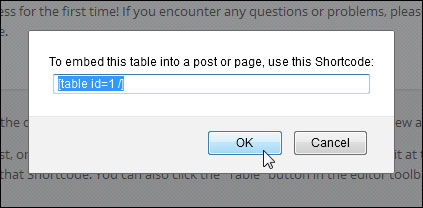
Get the shortcode for your tables by clicking on the Show Shortcode menu item under the table title to get the shortcode …
The plugin also adds a menu item to your WordPress editor. This allows you to easily insert tables into your posts and pages while working on your content.
Place your mouse cursor where you want the table to be inserted then click the TablePress menu icon …
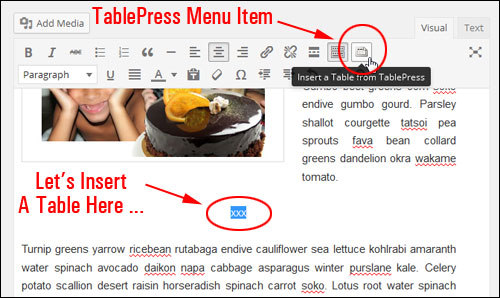
TablePress Menu Icon In Visual Editor Screen
Note: You can also add a table when working in the “Text” area of the WordPress editor …
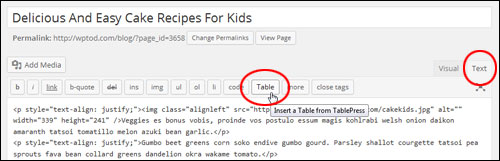
TablePress Menu Icon In Text Editor Screen
Clicking on the menu icon displays a list of your tables.
Select the table you want to embed in the post or page and click Insert Shortcode …
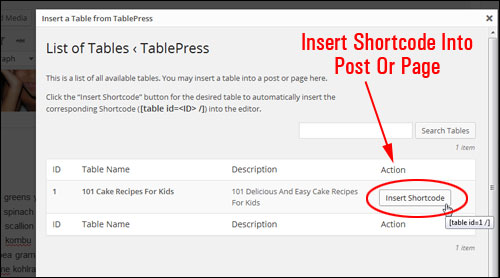
Your TablePress shortcode will be inserted …
Publish the post or page to display your table …

As stated earlier, one of the great things about this plugin is that you can edit things after publishing the table without having to edit your post or page. Edit the content in the plugin area, then save the new table settings and refresh your page to view the updated information.
Another great time-saving feature of the TablePress plugin, is that if you plan to keep adding data to an existing table, you can simply export your current table, then add new items, make changes, etc. You can then re-import your exported file with the news changes and your table content will be automatically updated throughout your site.
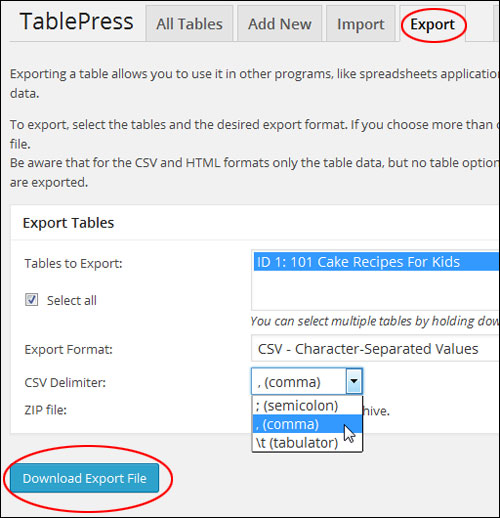
To export an existing table, select TablePress > Export a Table in the admin menu …
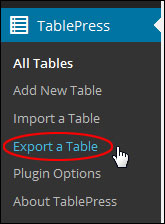
In the “Export Tables” section, select the table(s) you would like to export (tip: select multiple tables by holding down the “Ctrl” key), then select the Export Format you want(e.g. CSV) and any other export options you’d like to make and click on the Export Table button to download the table file to your hard drive …
After making changes and resaving your table file, you can then reimport the table into WordPress.
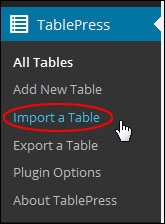
To import a table into WordPress, select TablePress > Import a Table …
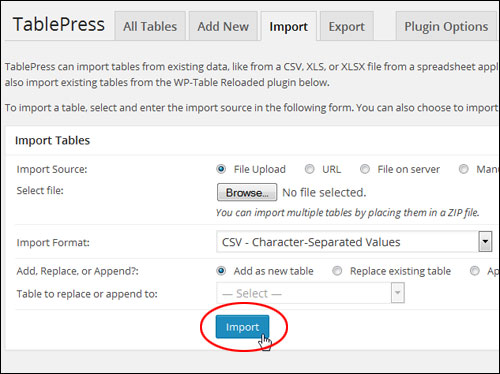
TablePress can import tables from existing data, such as CSV file data, from a spreadsheet application, an HTML file resembling a webpage, or its own JSON format.
To import a table, select and enter the import source in the “Import Tables” area. You can import multiple tables from compressed (ZIP) files and choose whether to import a table as a new table or replace an existing table.
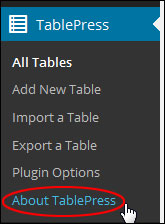
For more information about using the plugin, including where to access the plugin documentation for additional features, get plugin support, contact the plugin author, etc., click on the “About Tab” in the plugin admin section, or select TablePress > About TablePress …
As you can see, TablePress is quite a powerful and feature-rich free plugin will help you easily create and embed tables into your WordPress posts and pages.
***
"These tutorials have so much information and are easy to understand. If you use WordPress or plan to in the future these will help you with everything you need to know." - Valisa (Mesa, Arizona)