 No matter what your business sells or what industry you belong to, providing quality information to your blog users is important. For example, if your business provides travel-related services, it’s a good idea to publish useful information from government departments and foreign travel offices, such as news or updates on travel warnings, tips from consular offices, etc.
The problem with providing this type of information, however, is that it is really time-consuming. You have to do a lot of information gathering, researching and organizing, fact-checking, content writing and editing (or hire someone to do this for you), and then continually ensure that this information is kept up-to-date. As you can imagine, this is not only a lot of work but most of the information you are dealing with is well beyond your control.
Fortunately, there is an easier way to continually provide your users with great information.
It’s called RSS …

(RSS - One of the easiest ways to provide your readers with up-to-date information)
The Ultimate Guide To WordPress RSS
What Is RSS?
- RSS, which, according to some definitions is short for RDF Site Summary, is more commonly known as Really Simple Syndication. It is often called a “feed” or “news feed”.
- Once users subscribe to an RSS feed, they no longer have to manually check the website for content updates. Instead, their web browser will continually monitor the content and automatically keep subscribers up-to-date.
- Feeds are often used to publish information that is frequently updated, such as new blog posts, news headlines, videos, etc., to which any user can choose to subscribe.
- Essentially, an RSS feed is a structured XML document that includes either full or summarized text along with metadata like date of publishing, author, etc. It allows people to subscribe to content on websites and then keep up with any updates posted on these websites using an RSS feed reader. Conversely, RSS feeds also enable publishers to syndicate web content automatically.
- There are different kinds of feeds, read by different aggregators. Some of these include RSS feeds, Atom Publishing Protocol) feeds and RDF (RDF = Resource Description Framework) feeds. All of these formats, however, use a standard XML file format to ensure compatibility with different machines and programs.
- Many sites and software applications also let you combine many RSS feeds to receive news and updates from different sources.
This article explains where your RSS feed is located, how to syndicate your content online using feeds, and how to add someone else’s content to your site using RSS feeds.
RSS (Really Simple Syndication) Feeds
Content syndication is a very powerful way of sharing web content. Feeds provide web users with a way to receive the latest information published on sites they are interested in.
First, let’s look at content syndication.
Online newspapers rely on content syndication to publish newsworthy content from news agencies around the world.
Content syndication allows many content publishing agencies and leading online publications to deliver readers the latest news items from around the planet without having to employ additional staff in every location around the world …
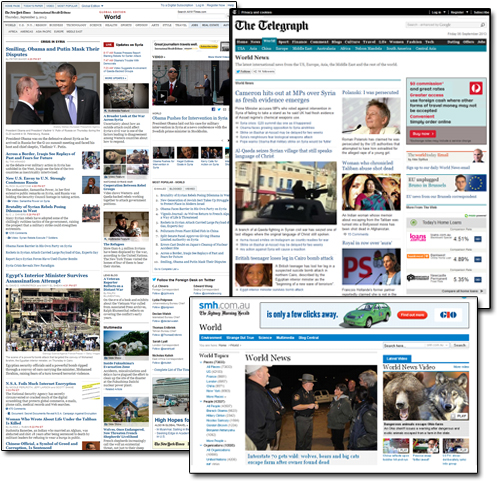
(Media publications rely on content syndication to publish newsworthy content from news sources around the world.)
Syndication is a legitimate method of sharing newsworthy content with other sites. online media publications syndicate their information using feeds …
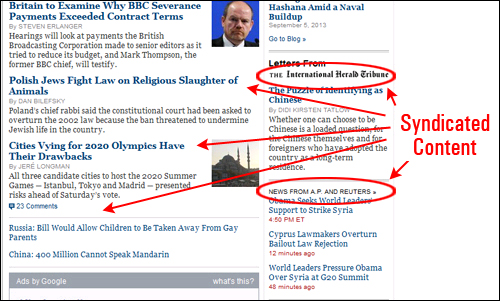
(Content syndication is used by global media publications to share content with other publications)
Most sites actually want you to share their content. Content syndication not only allows high-quality information to be shared, but it can also send visitors back to the original site that published the content being syndicated. This creates links that can drive traffic back to their site.
Many content publishing agencies and major content sites contain a feed section (look for menu links that say ”RSS”, “Syndication”, or “Newsfeeds” in them, or just search for “name of site/keyword + rss” – e.g. “nytimes rss”, “texas tribune rss”, “sydney morning herald rss”, etc.) …
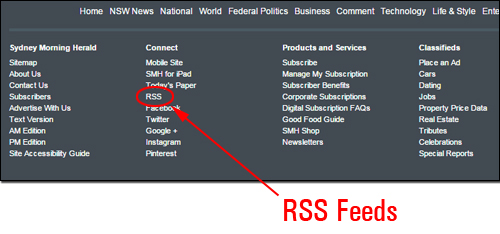
(Most news reporting agencies and major sites have an RSS feed section. Source: SMH )
Clicking on a site’s RSS feeds section brings up a directory of different RSS feed sections …
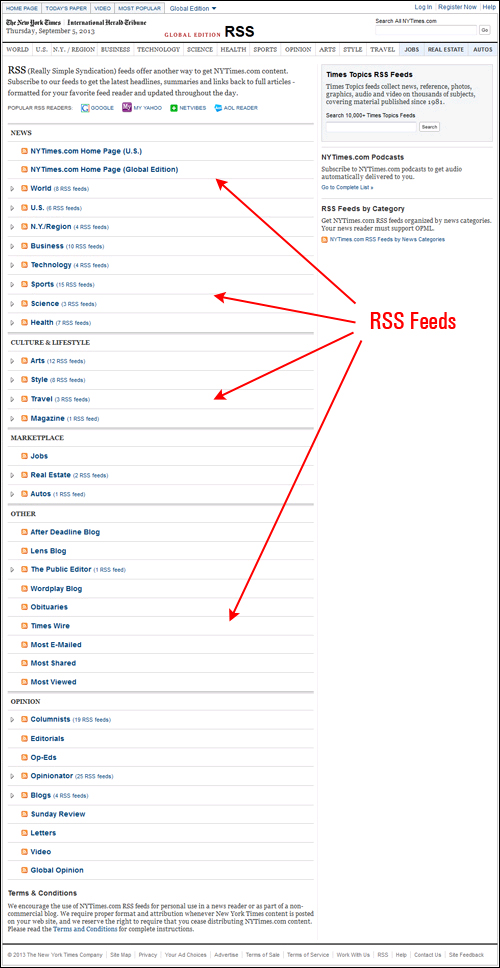
(A site’s list of RSS feeds. Source: nytimes.com)
These RSS feeds give readers access to information from different areas of the site (e.g. business news, travel news, jobs, etc.)
Feed sections can also include further feed subdirectories …
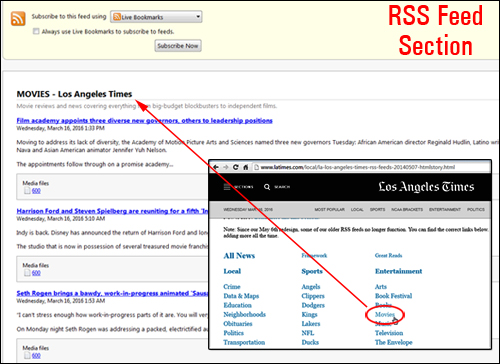
(An RSS list can also contain subcategories. Source: latimes.com)

Note: A feed is just a URL. All you have to do to use a feed is to copy the URL and paste it into an application that can process the feed into something readable. We’ll cover this further below.
The Benefits Of Syndicating Content
Adding content from someone else’s site on your website has some obvious benefits. It not only helps someone else’s business, it also adds value to your site without you having to create the content …
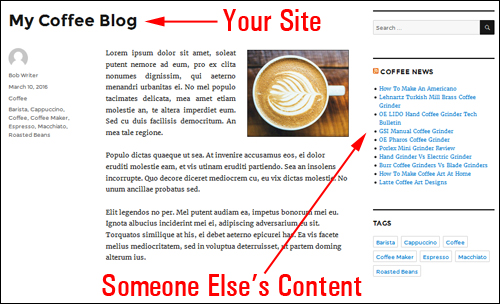
(Content Syndication Benefits Someone Else’s Website And Yours!)
While adding RSS feeds from another site is a great way to add content to your site that you don’t have to create, it’s worth keeping in mind that there are benefits in getting other websites to syndicate your content.
When other websites and blogs syndicate your RSS feed, this gives you the opportunity to gain more exposure online and drive more visitors …
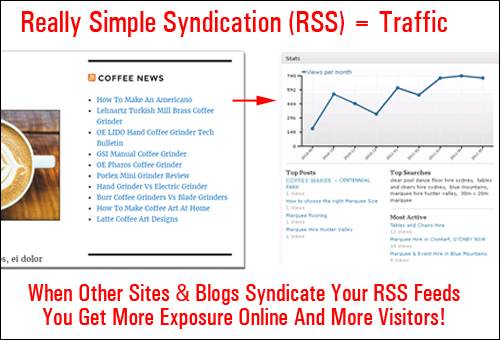
(Get other website owners to syndicate content using your RSS feed … it will help drive more traffic to your site!)
Overview Of The WordPress Feed
WordPress automatically publishes a feed of your latest posts, allowing others to easily syndicate your content on their websites and blogs.
Depending on the WordPress theme you have installed, there are a number of ways to access your RSS feed:
1) If your theme displays the Meta widget on the sidebar …
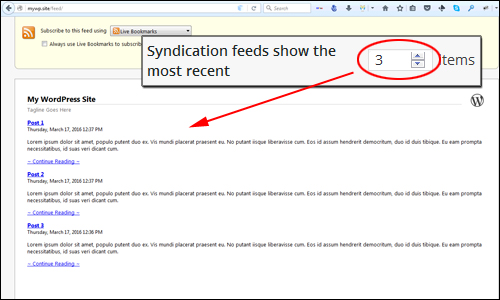
(The feed page will show the number of posts as you have specified in your WordPress Reading Settings section)
Display Full Text Or Summary Of Posts In Your RSS Feed
The other setting in the WP Reading Settings section that affects your RSS feed is whether to display posts in your feed as full text, or just a summary …

(Settings – Reading Settings – ’For each article in a feed show’ options)

Post Excerpts can also affect how the content in your feed displays …
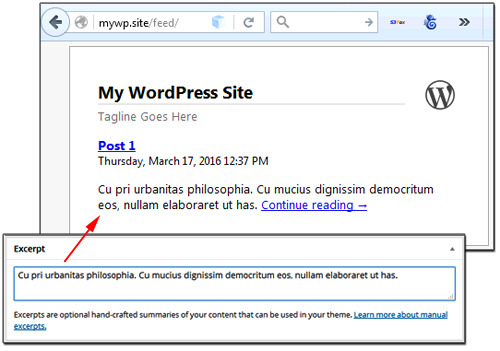
(Post excerpts affect how content in your feeds will appear)
To learn more about Post excerpts, see this tutorial:
View The Content Of Your RSS Feeds
As mentioned previously, to view a feed’s content, you need to copy the feed’s URL to your clipboard and paste it into an application that translates feeds into readable content.
Let’s take a look at how this works.
First, find a website or blog and look for their RSS feed icon using any of the methods described earlier …
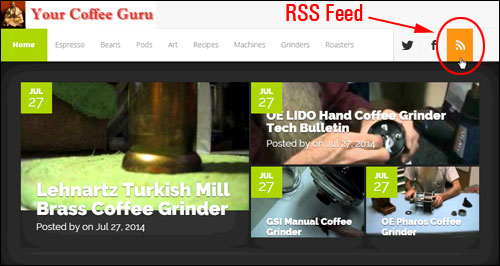
(Look for a ‘subscribe’ link. Image source: YourCoffeeGuru.com)
Next, copy the feed URL to your clipboard …
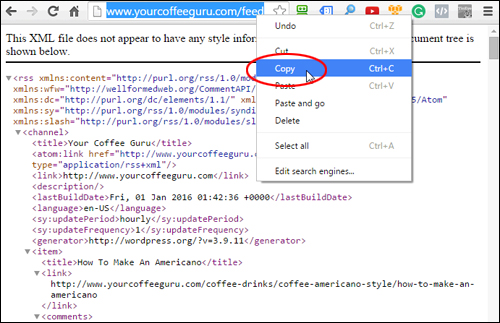
(Copy the URL of your feed)
If you want, you can check what the feed contains by pasting the feed URL into an online feed reader …
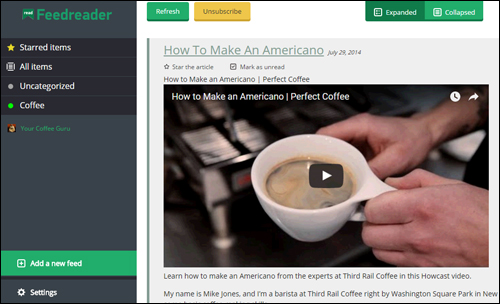
(Paste the URL of your feed into a feed reader to view the content. Image: Feedreader.com)
Like feed readers, WordPress also has the ability to process RSS feeds and convert these into readable content.
Adding An RSS Feed To WordPress
In the example below, we are going to add content from other sites to yours.
How To Add An RSS Feed To Your Sidebar
As mentioned earlier, no matter what industry you are in, you can add to your site the latest news from an industry-related government department or authoritative site in your industry by simply importing their feed. You can easily display a range of information on your WordPress site such as news, Facebook updates, or content from thousands of sites using the WordPress RSS widget.
Let’s add content from an RSS feed to the WordPress sidebar navigation area …
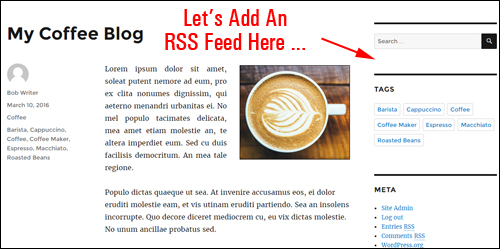
(Let’s add content from an RSS feed to your sidebar)
copy the RSS feed URL from a website that publishes content that you want to add to your site …
(Copy the feed URL)
Next, paste the feed into a new RSS widget …
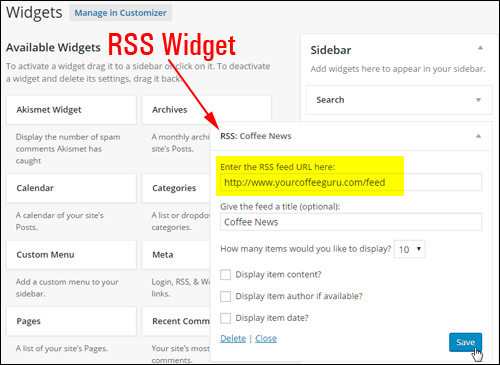
(Widgets Screen – RSS Widget)
To learn more about adding content to sidebars using widgets, go here:
Load your site in your browser. The content from the RSS feed will now appear in the sidebar …
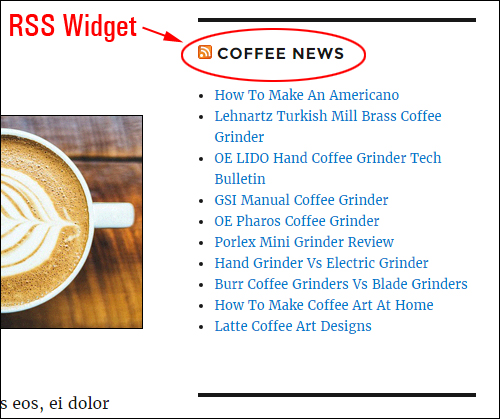
(RSS Feed Content Added To Sidebar)
Add Your WordPress RSS Feed To Search Consoles
You can add your WordPress RSS feed to Google and Bing’s search consoles. This will help them index your content faster.
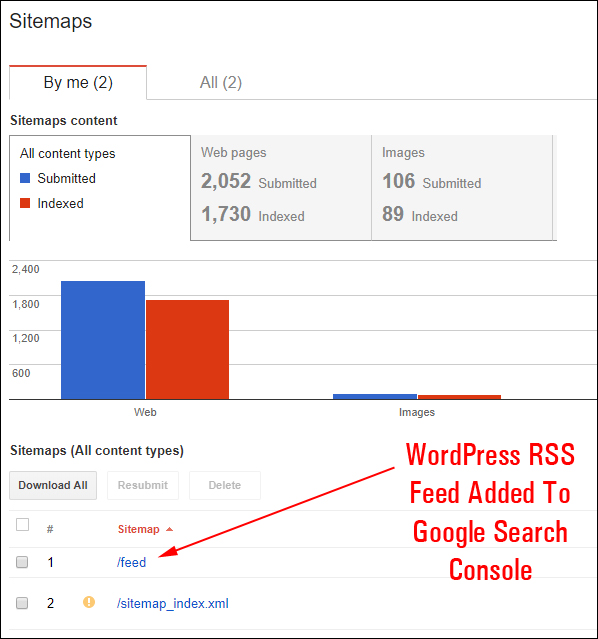
(WordPress RSS feed added to Google Search Console)
Adding your site’s RSS feed to search consoles is simple, fast, easy, and requires no technical skills. For a step-by-step tutorial, go here:
How To Add Feed Content To Your Posts
What if you want to add content from an RSS feed to posts instead of your sidebar?
You can easily do this using plugins. Search inside the Plugins admin section (Plugins > Add New) for RSS Post, RSS feed to post, etc.
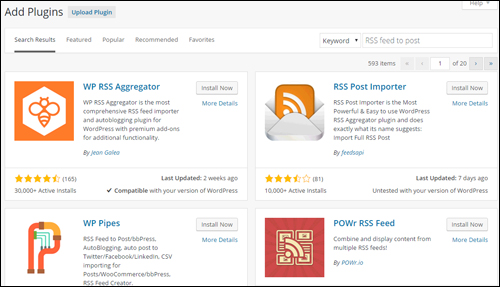
(’Add Plugins’ section)
Note: These plugins typically require configuration – visit the plugin sites for complete instructions, or contact us if you need help configuring plugins.
Here are some auto blogging tools that let you create new with RSS feeds and imported content:
WPeMatico
(WPeMatico)
WPeMatico is an auto blogging plugin that lets you publish posts automatically from specific RSS/Atom feeds.
You can manage all of your imported feeds and organize them into categories.
For more details, go here:
WP RSS Aggregator

(WP RSS Aggregator Plugin)
WP RSS Aggregator is an RSS feed importer and autoblogging WordPress plugin that offers a number of premium add-ons for additional functionality.
For example, the Feed to Post extension is an advanced importer that lets you autoblog by importing RSS feeds directly into WordPress posts or any other custom post type.
For more details, go here:
RSS Post Importer
(RSS Post Importer WordPress Plugin)
RSS Post Importer allows you to syndicate, import, curate, merge and display full-text feeds (RSS, Atom, etc.) on your WordPress website or blog.
The plugin will fetch an RSS feed and publish the full content of each item in the feed as a separate post.
For more details, go here:
Powr RSS Feed
(Powr RSS Feed Plugin)
POWr RSS automatically combines and displays content from multiple content using RSS feeds.
The POWr RSS plugin also lets you display images, videos, and articles, adjust feed size and spacing, use custom backgrounds, fonts, colors, and more. It is also mobile responsive and supports text in any language.
The premium plugin edition contains a number of additional features.
For more details, go here:
WP Pipes
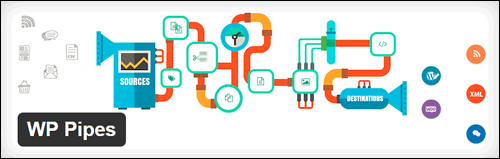
(WP Pipes – WordPress Plugin)
WP Pipes is a powerful data migration plugin that allows you to create curate content from RSS feeds, Google News, and many other sources.
This plugin provides functionality like CSV importing for posts/WooCommerce, RSS feed creator, auto blogging, auto post to Facebook/Twitter/LinkedIn, export WordPress posts as podcasts, create Google XML sitemaps, and help take your WordPress CMS to new levels.
For more details, go here:
FeedWordPress

(FeedWordPress – WordPress Plugin)
FeedWordPress is a simple and flexible syndication plugin for WordPress.
As stated in the FeedWordPress site …
FeedWordPress is an open-source Atom/RSS aggregator for the WordPress blog publishing platform. You set up feeds that you choose, and FeedWordPress syndicates posts from those sources into your WordPress posts table, where they can be displayed by your WordPress templates like any other post — but with additional meta-data, so that your templates can properly attribute the post to the source it came from.
You can use this plugin to create aggregator sites, or display all your online activity in one place.
For more details, go here:
Autoblog by WPMUDev
(Autoblog)
Autoblog is an easy-to-use plugin that can be set-up very quickly, without coding skills or complicated instructions. Simply copy and paste in your feed URL, give it a name of your choosing (for admin purposes) and select a blog to post content to.
For more details, go here:
RSS Includes Pages
(RSS Includes Pages and Custom Post Types Plugin)
RSS Includes Pages and Custom Post Types lets you display pages in your WordPress RSS feed in addition to posts.
For more details, go here:
Useful Tips
Tip #1 – WordPress Comment RSS Feeds
In addition to giving online users access to RSS feeds of your posts, WordPress also makes available RSS feeds of your latest post comments.
You can access these by clicking on Comments RSS in the ‘Meta’ widget area of your sidebar (note: your theme may not be configured to display this widget) …
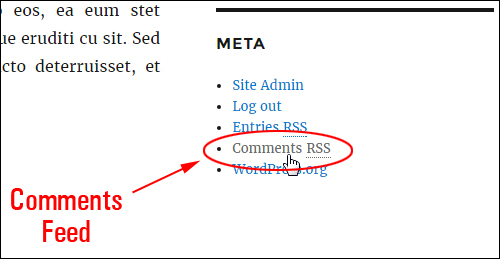
(Comments RSS)
All the comments posted on your site by visitors will appear in your Comments RSS page …
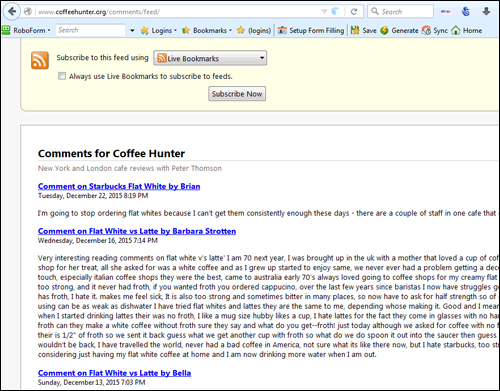
(Comments feed entries as seen on Firefox)
Like post entries, your comments feed page will display differently depending on which browser you are using …
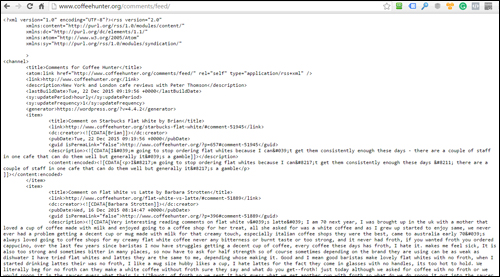
(RSS comments feed content displayed using a Google Chrome browser)
Again, you can check the feed content by pasting the feed URL into an online feed reader …
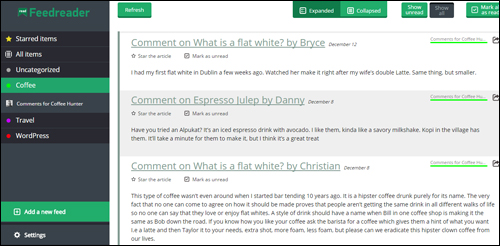
(Paste the URL of your comments feed into a feedreader to view the feed content. Image: Feedreader.com)
Note: If the Meta section is not displaying on your theme, you can view the Comments RSS section of your site by opening up a browser and typing in the following URL:
- http://www.yourdomain.com/comments/feed
- http://www.yourdomain.com/blog/comments/feed (if your site has been installed in a subfolder, e.g. “blog”)
Tip #2 – Individual Item Feeds
Being able to select an RSS feed for a specific post can be useful. For example, you may want to add feeds from specific posts to RSS directories, or you may have created a valuable resource that other online users will want to syndicate.
The formula for accessing an RSS feed for specific posts is shown below:

(RSS Feed For Single Post Item)
To create the above feed, copy the post URI, and append “/feed/?withoutcomments=1” to the end.
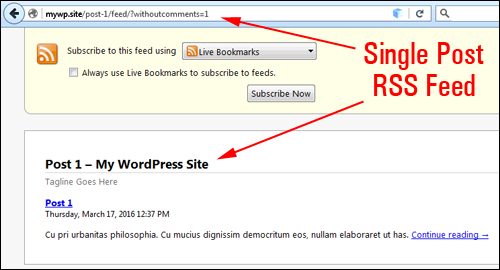
(Single Post Feed)
Note: By default, if you only append “/feed” to the end of the web address of your post, WordPress will return the comments left on that post, not the content of the post itself.
Tip #3 – Category Feeds
Some your site users may only be interested in subscribing to content from one or two categories. They may not want to subscribe to all of your site’s content.
WordPress allows you to create category feeds.
All you have to do is use the format shown below:

(Format for WordPress category feed)
Select and copy the category URL …
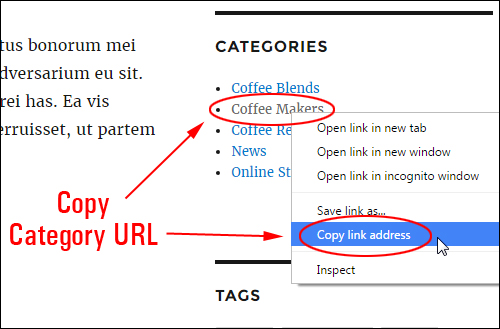
(Copy your category URL …)
Now, add “feed” to the end of it …

(Format for WordPress category feed)
The feed will now only display content posted under this category …
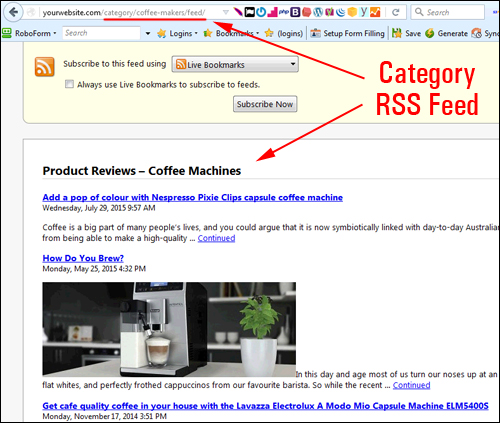
(Category-specific RSS feed page)
The WordPress Codex also provides different ways to create feeds not just for post categories, but also feeds for tags, authors, search, etc.
For this example, let’s create a feed for a specific post category using the format shown below:

(Post Category feed format. Source: WordPress Codex)
Here is the feed format WordPress recommends using. In this example, the post category ID is ’42’. We’ll need to replace the post category ID and the domain name …

(WordPress post category feed format)
To find the post category ID, go to Posts > Categories …
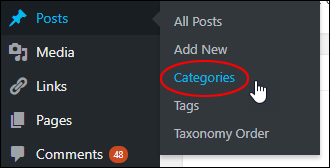
(Posts > Categories menu)
Locate the post category you want and hover your mouse over the title to reveal its unique ID …
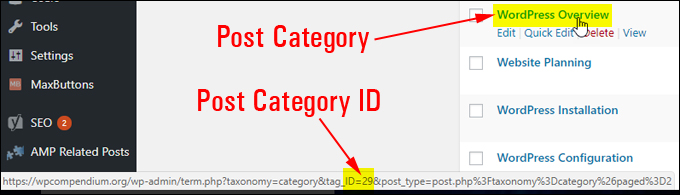
(Post Category ID)
In our example, the post category ID is ’29’ and the post category feed format we need to use for this specific category with our domain name looks like this …

(Post category feed format with domain name and ID)
Copy and paste the feed into your browser and hit enter …
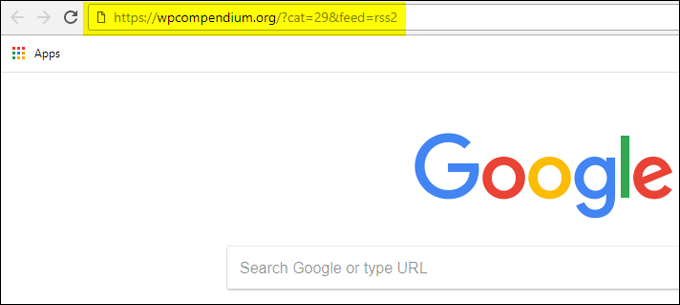
(Paste the feed into your browser)
This will display the feed for that specific category …
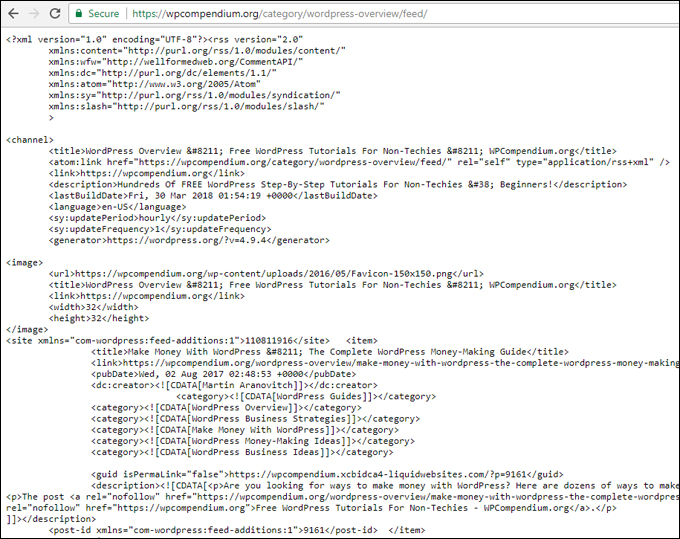
(RSS feed of a specific post category)
Note that in this example, WordPress automatically converted the feed format we pasted into the browser into the category feed we had used in the previous section of this tutorial …
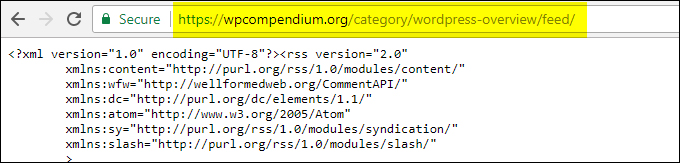
(Post category feed format)
Here is the feed format again …

(Post category feed)
In this case, the simplest way to create additional feeds for specific categories is to simply change the post category slug …

(Change the post category slug to create a new category specific feed)
Paste the edited feed into your web browser and hit enter to display the content for that specific category’s feed …
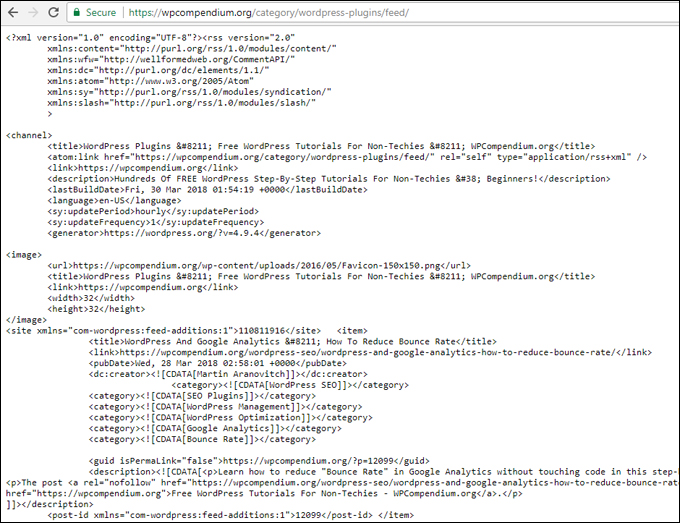
(Post category feed content)
Now that you have a method for creating feeds for specific post categories (or tags, authors, etc.), you can even create a directory or list of individual feeds for visitors.
Tip #4 – Create Your Own Feeds Directory
You can provide your own feeds page that allows your readers to subscribe to specific content …
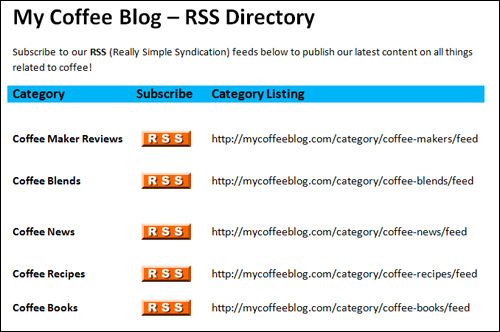
(Create Your Own Directory Of RSS Feeds)
Link a button graphic to the URL of your category feed and then create a table or a list of all feeds on a separate page …

(RSS icon. Source: http://www.public-domain-photos.com/free-cliparts/computer/other/rss_button_roman_bertle_01-2522.htm)
We have written a detailed tutorial on creating tables in WordPress content here:
RSS – Additional Notes
Feeds can be customized in a number of ways, such as adding images and videos to feeds, ads, etc. Some of these customizations require code editing skills.
WordPress allows you to configure several feed types without touching code. Here are some examples of custom feed formats you can display …
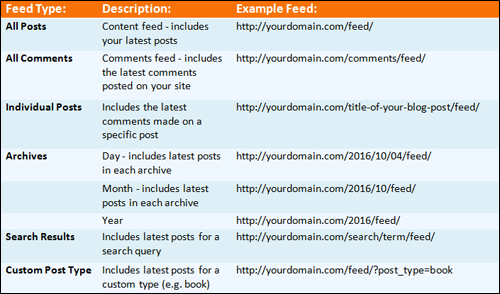
(Different Feed Types You Can Create With WordPress RSS)
For your convenience, here are the feed types, descriptions, and feed examples listed above:
- Feed Type: All Posts
- Description: Content feed – Feed that displays your latest posts
- Example Feed: http://yourdomain.com/feed/
- Feed Type: All Comments
- Description: Comments feed – Feed that includes the latest comments published on your blog
- Example Feed: http://yourdomain.com/comments/feed/
- Feed Type: Individual Posts
- Description: RSS feed containing an individual post entry
- Example Feed: http://yourdomain.com/blog-post-title/feed/
- Feed Type: Individual Posts Comments
- Description: Contains the latest comments made on specific items
- Example Feed: http://yourdomain.com/title-of-blog-post/feed/
- Feed Type: Archives
- Description: Day – Displays latest posts in each archive
- Example Feed: http://yourdomain.com/2015/11/02/feed/
- Feed Type: Archives
- Description: Month – RSS feed containing latest items in each archive
- Example Feed: http://yourdomain.com/2015/03/feed/
- Feed Type: Archives
- Description: Year – RSS feed that displays the latest entries in each archive
- Example Feed: http://yourdomain.com/2016/feed/
- Feed Type: Search Results
- Description: Includes the latest items for a search query
- Example Feed: http://yourdomain.com/search/term/feed/
- Feed Type: Custom Post Type
- Description: Includes latest posts for a custom type (e.g. book)
- Example Feed: http://yourdomain.com/feed/?post_type=book
One last thing …
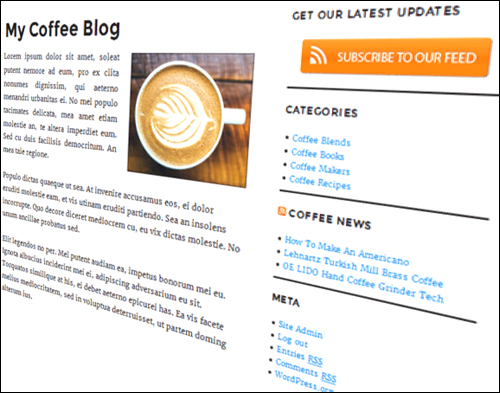
Remember to let your site visitors know that they can subscribe to your feed. Make sure you place a ’subscribe to RSS’ buttons in a visible location …
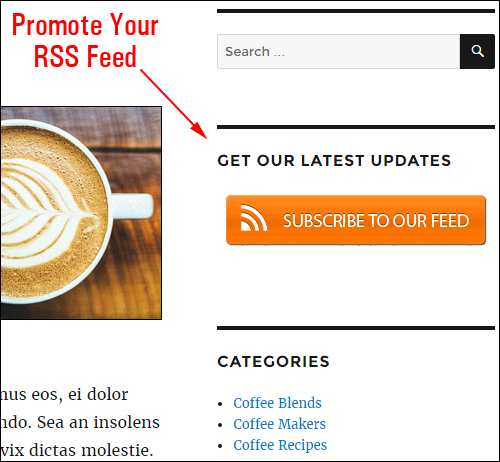
(Remember to make your RSS feeds visible your RSS feeds!)
Also, keep in mind that other website owners will only subscribe to your content if you provide your visitors with high-quality content that will add value to their sites and benefit their visitors.
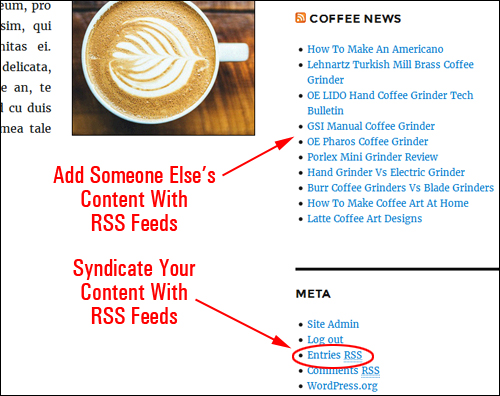
(Easily add content from other sites and get others to share your content with RSS!)
If you need great content ideas subscribe to our FREE content creation course using the form below:
Also, don’t forget to subscribe to our RSS feed 🙂
Resources:
- RSS Icons – Visit sites like iconspedia.com/search/rss or search online (e.g. “free rss icons”, “rss logo”, etc.) for sites containing downloadable RSS graphic elements.
- RSSBoard.org – The RSS Advisory Board provides useful information about RSS.
- Wikipedia.org/RSS – General information about the history and benefits of using RSS.
- WordPress Codex: Feeds – WordPress software documentation and reference site. Visit this site for additional information about feeds in WordPress.
Congratulations! Now you know how to find your WordPress RSS feed, how to syndicate your content online using RSS feeds, and how to add content from other websites and blogs to your site via their RSS feed.
Hopefully, you now have a better understanding of problems that can affect your website and how WordPress can help you build a better business online. To read more about the benefits of using WordPress for a business website or blog please click on links to visit other great content we have published on this site.
***
"I am beyond impressed with what you have put together. I can tell that you put a ton of hard work into building what you have. You have the absolute best content on WordPress I have ever seen!" - Robert T. Jillie