 Do you sell products online worldwide? If so, you may want to consider providing users with currency conversion.
Currency conversion software tools allow your web visitors to have the price of a foreign currency transaction translated to their home currency at the purchase or checkout stage. It also allows your visitors to view the exact amount their card or PayPal account will be charged, expressed in their home currency.
The obvious advantage of adding currency conversion is that it lets your customers see and understand prices in foreign countries in their own home currency, and makes it easier for customers to calculate their costs and expenses.
If you are a WordPress user, it’s easy to add a currency converter to currency conversion to your website via a plugin, allowing your visitors to quickly perform currency conversions to determine the cost of your goods.
Currencyr
Currencyr is an intuitive, easy-to-use and complete currency converter WP plugin with a visually attractive converter tooltip. It’s also free!
The Currencyr useful WordPress plugin includes features such as:
- In-line conversion tool
- Supports several exchange rates providers, such as Google, Open Exchange Rates & European Central Bank
- Supports Shortcodes
- Widgetized currency table and converter
- Can be integrated with a number of e-commerce plugins like WooCommerce, WP-eCommerce, Shopp, and Easy Digital Downloads.
- Can detect local currency automatically
- Translation support
Note: The Currencyr plugin requires your server to be running PHP 5.3.0 or later. Do not install this plugin if you are running an older version of PHP on your server. Alternatively, ask your web host to upgrade your PHP server installation if required.
***
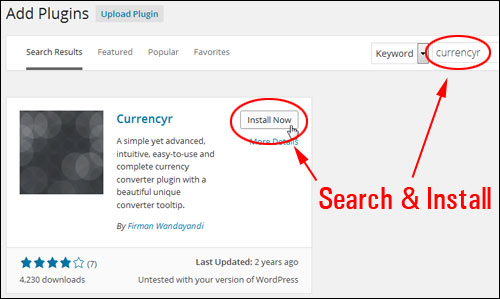
You can install the plugin from your WP admin area by typing in “currencyr” into the Plugins search field and clicking the ”Install Now” button …
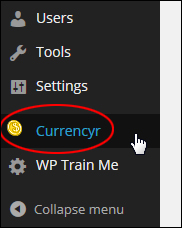
When you have installed and activated the plugin, you can configure the plugin’s settings by selecting Currencyr from your admin user area …
The plugin settings area provides several configuration settings …
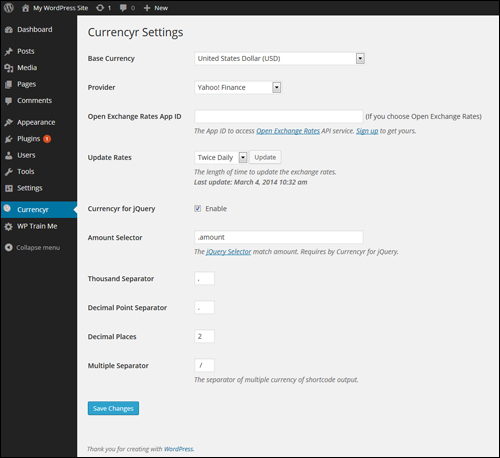
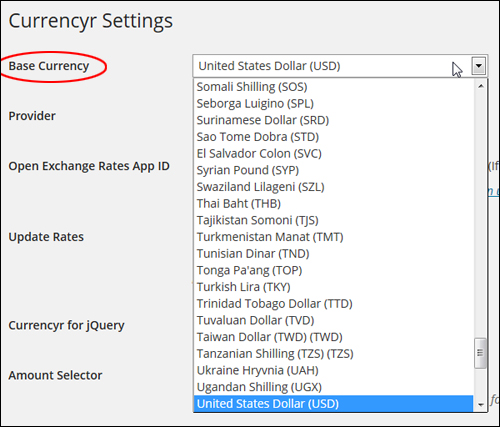
For example, you can select your base currency from a dropdown menu. The default base currency is ‘USD’ …
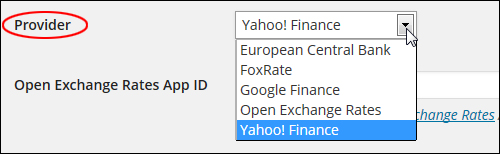
Similarly, you can select a data provider from a dropdown menu. The default selection is Yahoo Finance, but you can select one of the other options, such as European Central Bank, FoxRate, Google Finance or Open Exchange Rates …
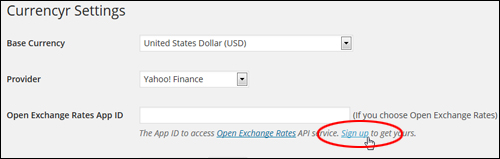
Note: If you choose ‘Open Exchange Rates’, you will need an API (Application Programming Interface) ID …
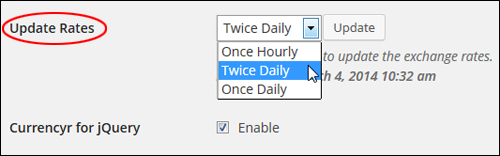
You can select how frequently you want to update the exchange rates by choosing an option from the ‘Update Rates’ dropdown menu …
The Currencyr plugin uses jQuery, which allows web developers to add things like animation effects to web applications (e.g. WordPress plugins).
If you have no reason to change the jQuery settings, leave them as they are …
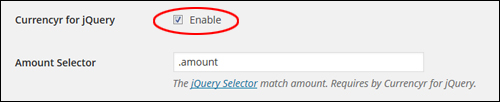
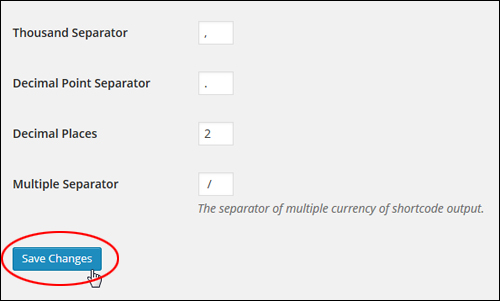
Configure the rest of the plugin settings according to your preferences and remember to click Save Changes when you have configured all of your settings …
After your plugin settings have been configured, you can add currency conversion to any WordPress page using a shortcode.
See the ‘Additional Plugin Notes’ section at the end of this tutorial to learn more about using currency codes (e.g. USD, AUD, ZAR, etc …) with the Currencyr plugin.
Currencyr Shortcodes
You can add currency conversion to pages, posts and widgets with no web coding knowledge or skills using shortcodes.
Below are some examples of currency shortcodes that you can add to WordPress pages and posts:
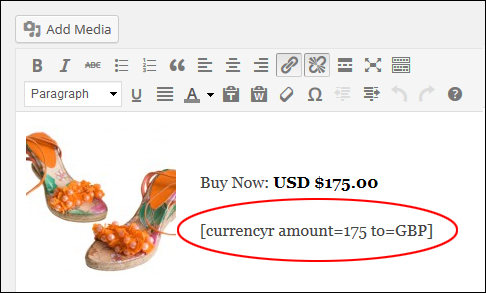
Let’s say that you retail a product on your website for a set amount (e.g. $175) in US Dollars (USD), and you want to display your conversion amount in British pounds (GBP) on your sales page.
To do this, simply insert the shortcode below to your page content …

Note: You can also display pricing in dollars and cents (e.g. 188.35, 97.00, 149.00, etc …)
The example below shows how the above shortcode should look after you have added it to your page …
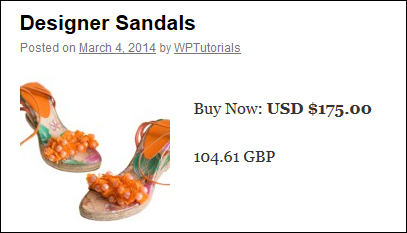
After publishing your post or page, your converted currency will then appear as shown in the screenshot below …
Using the above example, let’s also translate the same price into multiple currencies.
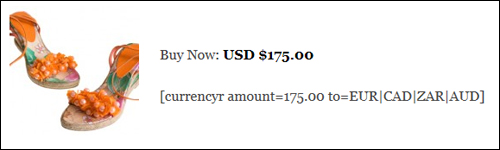
To do this, use following shortcode (add as many currency symbols as you want separated by vertical pipes) …

The screenshot below now shows how the above shortcode appears when you add it to a page …
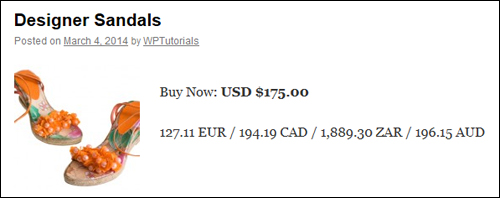
Once the page has been published, the converted currency will then display as you can see below …
See the ‘Additional Plugin Notes’ section at the end of this tutorial to learn more about changing the currency separator symbol in the Currencyr plugin.
Now, suppose you would like to use a different base currency than the one you have set as the default.
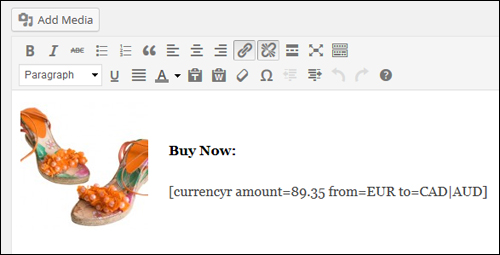
For example, if you have set your default base currency as EUR and you have a section on your website targeted to non-European visitors (for example, Australia or Canada), you can change the base currency using the following shortcode …

The screenshot below shows how the shortcode appears when inserted into a post …
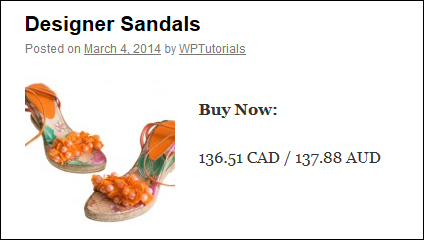
Once the page has been published, your converted currency will then appear as seen in the screenshot below …
How To Use The Currencyr Widget
You can also add a currency converter to your website or blog’s sidebar using the plugin’s widget.
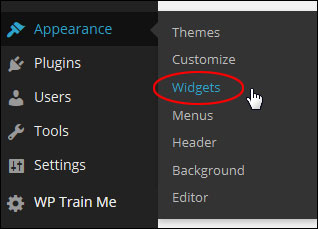
To add currency conversion to your sidebar area, select Appearance > Widgets from your WordPress dashboard menu …
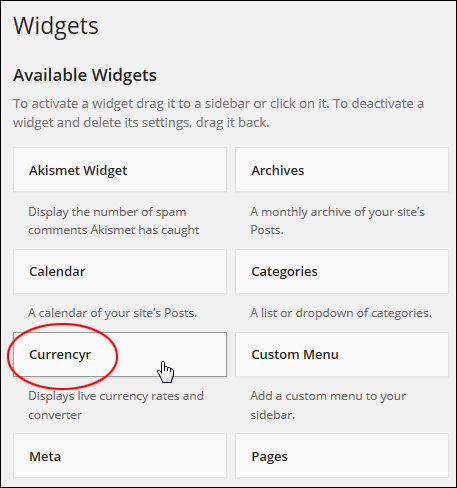
In the Widgets > Available Widgets section find the ‘Currencyr’ widget and add it to an ‘Active Widgets’ location …
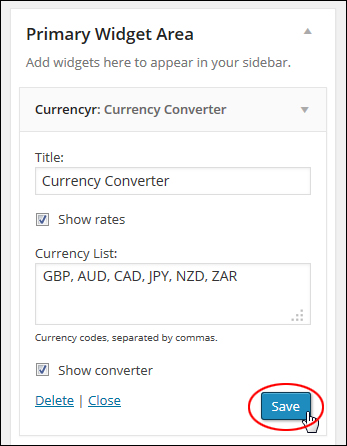
Configure the widget settings as shown in the screenshot below (add any currency codes you want to display on your widget separated by a comma), and click Save to update your settings …
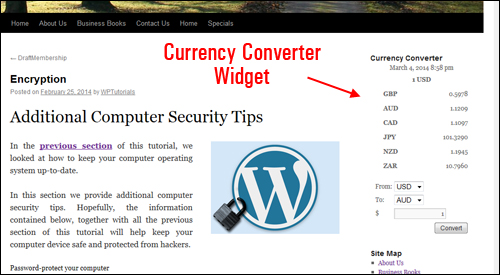
The currency converter will now display on your site’s sidebar menu with the settings you have selected …
Additional Plugin Notes
Here are some additional notes and useful information about using the plugin.
Currency Separator
The Currencyr plugin lets you specify a symbol of your choice to display as the currency separator when using several currencies.
You can change the symbol in the Multiple Separator settings field.
So, for example, using the default symbol “/” (forward slash) …

Separates all your currency values using the forward slash as shown below …
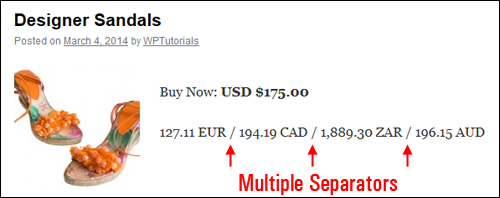
If you modify the symbol and update your plugin settings …

Your site visitors will see the new symbol being used as the currency separator …
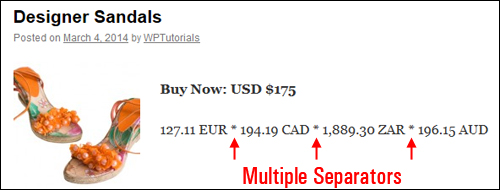
Integration With WordPress e-Commerce Software
As stated earlier, the plugin can be integrated with a number of WP-compatible e-commerce plugins such as WooCommerce, WP-eCommerce and Easy Digital Downloads …
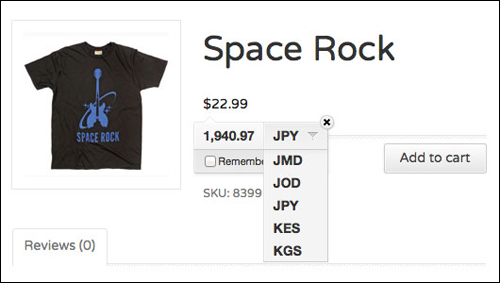
(image source: plugin site)
Congratulations! Now you know how to easily add currency conversion to your e-commerce site.
To learn more about WordPress e-commerce plugins, see the tutorial below:
***
"Wow! I never knew there's so much to learn about WordPress! I bought one of the WordPress for Dummies three years ago, such authors need to be on this course!" - Rich Law, Create A Blog Now