Build Your Reputation With User Testimonials And Reviews

Are you stuck doing what you’ve always done to attract and retain new customers, and getting the exact same disappointing results? Most business owners don’t need to be told that generating new business can be very difficult. Just trying to keep your business afloat requires a lot of time, money and energy, and sometimes this can feel like it’s just not worth the effort.
In today’s digital and social-driven economy, you cannot afford to ignore the significance of online consumer behavior, especially if they are posting comments about your business.

Don’t ignore what users may be saying online about your business!
By the same token, you are also doing your business a great disservice if you are not boosting the positive things your clients say about your products and services. Testimonials, user reviews, and case studies are effective ways of helping you promote and market your products and services online and should be included in your content.
In this article, you’ll learn how to turn more visitors into qualified prospects with compelling customer testimonials.
Testimonials And User Reviews
The great, legendary showman and successful promoter P.T. Barnum is often quoted as having said that “Nothing draws a crowd quite like a crowd.”
P.T. Barnum obviously understood the power of “social proof”. Social proof-driven content is a powerful and effective way of getting your business promoted. Reviews and testimonials from satisfied users are far more persuasive when it comes to drawing new customers, clients or users than anything you have to say about your own products or services.
There is an untapped source of business growth potential that most businesses just aren’t utilizing, or utilizing correctly … user reviews and testimonials!
Testimonials and consumer reviews are a great way to build credibility for your services and products.
Tests conducted by many leading firms all point to the same inevitable conclusion: adding testimonials and reviews to your sales information helps to eliminate doubts potential customers may have about products or services, helps with product selection and helps increase conversions of visitors into sales.
Below are just some of the statistics available to support this:
- According to research findings by eVoc Insights, a company known for researching and measuring user experience, “In general, 63% of users indicate they are more likely to purchase from a site if it has ratings and user reviews.”
- According to Reevoo.com, customer reviews play a significant role in creating an average 18% uplift in sales and 50 or more consumer reviews per product can mean a 4.6% increase in conversion rates.
- Web site visitors who interact with both reviews and customer questions and answers are 105% more likely to purchase while visiting and spend 11% more than visitors who don’t interact with UGC. (Bazaarvoice, Conversation Index, Q2 2011).
- Customer reviews are significantly more trusted (nearly 12 times more) than descriptions that come from manufacturers, according to a survey of US internet users by online video review site EXPO. (eMarketer, February 2010).
(Source: eConsultancy.com)
Adding Customer Reviews – Managing Online Reputation
Adding great reviews and testimonials to your site from customers who are thrilled with the results they’ve obtained by using your products or services is important for helping you grow your business and creating a solid online reputation.
Customer testimonials and consumer reviews, however, can work both ways and affect your business both in a positive as well as negative way.
You see, people may not be saying bad things about your products directly to you, but they could post negative comments on Facebook about an unpleasant encounter they’ve just had with you or your business and this could be doing far more damage to your business than all the good work you’ve been putting into building it.
This is where online reputation management becomes vitally important to your business success.

Misconceptions about managing your reputation online, such as the process being too complicated or too time-consuming (or the belief that you really don’t need to worry about it) may be causing damage to your business without you even realizing this.

See this article to learn more about a WordPress plugin that can help you avoid the escalation of negative reviews about your products through effective customer review management:

Creating Awesome Testimonials – Useful Tips
Testimonials, user reviews, and case studies are effective ways of helping you market your products and services online and should be added to your content marketing strategy. When you include your own customer responses in your content, you:
- Show prospects exactly what pains and problems your products and services can help solve for them and how easily this can be done.
- Help site visitors identify their objections and address these.
- Help potential customers connect with their motivations and this facilitates moving them further along the sales process.
Below are some tips on creating testimonials:
- Avoid over-editing: Try to use the actual words used by your customers as much as possible. Leaving grammatical errors and misspelt words in the content helps keep your testimonials sounding authentic.
- Use real photos: Research shows that using images of people’s faces draws the attention of visitors on a web page. Adding client photos next to their testimonials and reviews will help your visitors and potential prospects take notice of your content.
- Tell a powerful story: Stories are so much more powerful and memorable than simply providing facts and statistics. The ability to present a customer’s horror story and how your solution saved the day will make a more lasting impression on those reading your content than using generic statements about how “excellent” your support has been and giving “two thumbs up” service recommendations that all of us have heard a “million times” before.
- Keep it in context: It’s good to add testimonials to your web content where it best makes sense to place them, and where they can most effectively help to sell your point. Think about the impact you can create on your visitor’s mind if you were to display a testimonial about what a “bargain” price your solution retails for before posting your price information, or testimonials about problems you’ve helped clients solve before talking about the benefits of your products, or testimonials where customers are truly thrilled about your support before offering a money-back guarantee or addressing objections.
- Quantify your information: Which of the following statements do you think your prospects would consider to be more powerful: “XYZ solution was directly responsible for increasing our sales by $21,598 in the previous fiscal year,” or “XYZ product has helped us grow our business?” Whenever possible, ask clients to specify quantifiable results when submitting testimonials, like how much your solution helped to increase their sales or reduce their costs in specific percentages or amounts, how many hours of work you have helped them save, how many new leads or new clients they were able to generate in a recent financial period, what kind of things are they able to do or experience now that they couldn’t do before, etc.
- Use different testimonials throughout your site: Although this can be somewhat difficult if you are just starting out or don’t have many clients, try to avoid displaying the same testimonial throughout your site. Depending on the nature of your business, you could try to obtain more client testimonials by offering limited review copies of your product, or a special launch discount for existing clients in exchange for an honest review and permission to publish it if you choose to use it.
- Appeal to your target audience: As every infomercial featuring a celebrity endorsement, subject expert or “busy mom” knows, if you know who your target audience is, providing testimonials from people who your prospects aspire to become can be a powerful motivator and influencer. People want to see and buy from “better versions” of themselves, so make sure to include testimonials targeted to your best audience demographic.
- Reprint testimonials across different platforms. If someone posts a great comment on your Facebook page praising your products or services, ask them for permission to reprint the content on your site.
- Only use real testimonials. Prospective customers need to see that the testimonials you provide on your site are real. Don’t compromise your integrity or reputation with false testimonials.
How To Get Client Testimonials
Just Ask
Getting a testimonial from a satisfied customer can be as simple as just asking for it.
Follow these useful tips for requesting testimonials:
- Contact clients after 30 days with an email reminder for a testimonial if you did not obtain one immediately after performing a service.
- Include a text box for testimonials in all client surveys.
- Take out your phone next time you meet with a client or hand over a finished job and if they are delighted with your services, ask them if they would be happy to record a very quick video testimonial/feedback interview. When recording the video, describe to your viewers what you have done for the client and make sure to record your client’s positive reactions and feedback.
- Make it easy for them. When a client sends you a positive email thanking you for a great service that contains snippets of useful testimonial material interspersed with the rest of their message, grab the juiciest sections (only use what they have written – never put words into their mouth), and use these to create a testimonial, then contact the client and ask them for permission to publish it. Explain that you have already prepared something to save them time and invite them to edit what you have written however they like before replying with their approval.
Offer To Publish A Link To The Source
Offer to add a link to their website in exchange for their testimonial. This is a great incentive for clients to provide you with a testimonial. It also makes the implicit statement to visitors that your testimonials are real and can be verified.
Add Testimonial Requests To Your Auto Responder/Newsletter Messages
If you have a list of subscribers, include requests for a testimonial in a regularly-spaced auto responder broadcast. Preferably, this should be timed to reach subscribers just after your customers have had a chance to measure the impact of using your products. Use words like “I need a quick favor” in your email subject and make the point of your email or message specifically about asking users for feedback, a testimonial, or a product review.
Use LinkedIn
The LinkedIn “Recommendations” feature helps you request testimonials from other members for your profile. With LinkedIn, the process for requesting and providing recommendations is user-friendly and the person who provides the recommendation gets a link to their profile. If you get a recommendation on LinkedIn, ask their permission to reprint it on your site (and offer to publish a link back to their website or profile in exchange).
Create A Client Testimonials Section On Your Site
Create a “Testimonials” page and add a “more testimonials …” link to your main testimonials section throughout your content sections.

Practical Tip: You can measure how useful testimonials are by how long visitors remain on the section of your pages or posts where you have added your testimonial content. A great tool for understanding visitor behaviour on your pages are “heatmaps”.
We have written an article about adding heatmap analytics to your website to monitor visitor behaviour here:
Useful Testimonial Plugins For WordPress
If your website or blog is built using WordPress, you can use a plugin to display testimonials. Some plugins also allow you to add forms to your pages where users can submit feedback and testimonials.
Once your plugin is installed and set up (with instructions for adding testimonials via the submission form – if available), all you have to do is send users to your “Testimonials” section.
Check out the plugins below:
Easy Testimonials
Easy Testimonials is a free WordPress plugin that lets you add testimonials to your sidebar as a widget, or embed them into your pages and posts using a shortcode. The Easy Testimonials plugin also lets you publish a list of all your testimonials or output a random testimonial, and include images with testimonials, which is great to add a photo of the testimonial author, a logo, etc.
The Easy Testimonials plugin also provides a “pro” version that offers additional features and plugin support.
Visit this site to learn more about this plugin:
Testimonials Widget

Testimonials Widget is a free WP plugin that lets you randomly slide or list selected portfolios, reviews, quotes, or text with images or videos on your website. You can insert testimonials via a shortcode, theme functions, or widgets with category and tag selections and specify different display options such as random or specific ordering.
The Testimonials Widget plugin makes loads of additional features available via a premium version, including built-in options for better search engine results and developer support.
Go here to download this plugin:
Testimonials WordPress Plugin
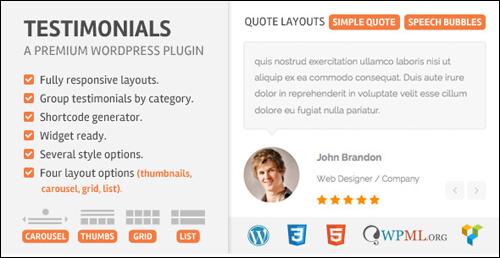
This premium WP plugin offers many great features right out of the box, including:
- Responsive design that resizes for displaying correctly on any device or browser.
- Display your testimonials in a widget or as sliders, slideshows, grid layout, list layout, etc. by adding a shortcode
- Styling options (display image on top, bottom, or side of testimonials, display testimonials in a speech bubble, customize font and background colours, font types and more.
For more information about the plugin, go here:

To learn how to add testimonials in WordPress, see the tutorial below:
In Summary …
User reviews and client testimonials are powerful sources of content that help your business add credibility, build authority, improve online reputation, and grow your sales funnel. Always ask for feedback, reviews, and testimonials from your clients or customers, and publish positive content about your business on your site.
Additional Info
The articles below are a great source of information on creating engaging customer testimonials and were helpful in providing research and information for sections of this article:
- Ecommerce Consumer Reviews: Why You Need Them And How To Use Them
- How To Create Captivating Customer Testimonials
- 5 Tips For Knockout Testimonials
- Make Customer Testimonials Meaningful
- 7 Simple But Powerful Customer Testimonial Examples You Can Steal
- Your 5-Minute Guide To Writing an Amazing LinkedIn Recommendation
- How To Get Great LinkedIn Recommendations
We also recommend subscribing to our Free Content Marketing Email Training Series. You will receive regular training emails with actionable information and practical tips that will teach exactly how to drive more traffic to your website or blog, save money creating high-quality content for your site visitors and grow your business online using content marketing. It’s not only a great course with loads of useful information, it’s also completely FREE!
***
***
"I have used the tutorials to teach all of my clients and it has probably never been so easy for everyone to learn WordPress ... Now I don't need to buy all these very expensive video courses that often don't deliver what they promise." - Stefan Wendt, Internet Marketing Success Group