 Savvy marketers understand that building a mailing list is one of the most valuable assets you can create for a business online.
This is because a list gives you traffic on demand and access to repeat sales.
It’s a well-known fact that, on average, 50%-80% of visitors to a site who leave will never return. That’s a lot of money you’re most certainly leaving on the table. Testing also shows that it takes an average of seven exposures to your business before a purchase decision is made. It’s so important, therefore, to interact repeatedly with visitors.
How can you do this, however, if most visitors never come back?
The answer, of course, is to capture your visitors’ email address while they’re still on your site, so you can build a relationship with them after they exit your website.
Building a list is an essential aspect of building a successful online business. A great list of contacts has the potential to become your most valuable asset.

If you sell one or more products on your website, or your business relies having a constant source of traffic, then building a list is essential, because it is the key to repeat visitors and building a relationship.
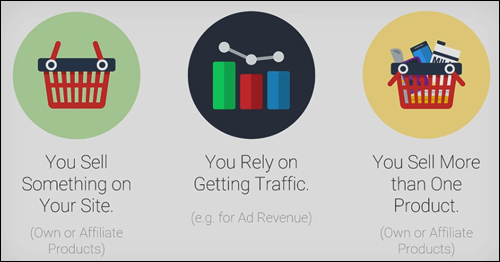
Now … there are many ways and different strategies to build an email list, but until very recently, it was very difficult to find one easy-to-use solution that takes advantage of most of the most effective methods available for capturing visitors’ email addresses on your website.
Thrive Leads – WP A/B Testing List Builder

Plugin Description
The Thrive Leads list builder for WP lets you build a list of subscribers quickly using a wide range of opt-in forms, split-test different offers, improve your conversions, and get traffic on call, working directly inside your WordPress dashboard …

As stated earlier, there are many ways and different strategies to build a subscriber list, and almost all of these methods and strategies involve subscription forms.
One of the key differences between Thrive Leads and other solutions that allow you to collect email addresses is that Thrive Leads comes with some of the most effective conversion and list-building strategies built into their plugin.
Thrive Leads WP mailing builder is developed by Thrive Themes, a conversion-focused WP theme developer. As you will soon learn, the plugin was developed to help users not just build a mailing list, but build it faster.

Learn more about this plugin here:
Plugin Benefits
Here are just a few of the benefits of using Thrive Leads to build a list of subscribers fast and get traffic on call on your site:
It’s WordPress
Thrive Leads list builder for WP eliminates the need to install multiple plugins on your website. This not only reduces the possibility of problems resulting from plugin conflicts, but also keeps your website’s loading speed down.
Easy & Fast To Install
Thrive Leads installs just like any WP plugin. Simply upload a zip file containing the plugin files to your Plugins folder via your WP dashboard and activate.
Very Simple To Use
With Thrive Leads, you can easily set up one or more opt-in forms, use their pre-designed form templates and start collecting email addresses. No technical skills or design skills are required at any point of the process.
To get the most out of the Thrive Leads plugin, you will want to implement all of the advanced targeting, testing and reporting features. If you are a new user, allow 30-60 minutes to learn how to use all of the plugin’s functionality. Fortunately, ThriveThemes provides extensive training content, webinars and a support team that is available to answer any questions you have.
Every Kind Of Form You Need
With the Thrive Leads plugin, you can begin to capture subscriber details using pre-designed templates, and every type of opt-in form you will ever need.
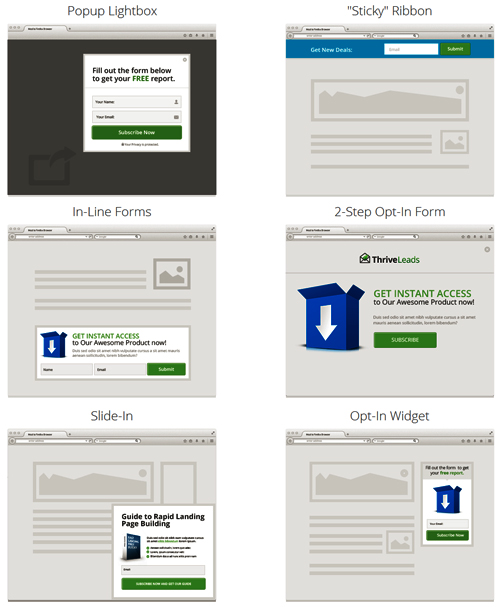
For example, you can use Thrive Leads to display attention-grabbing “pop-up” lightboxes …

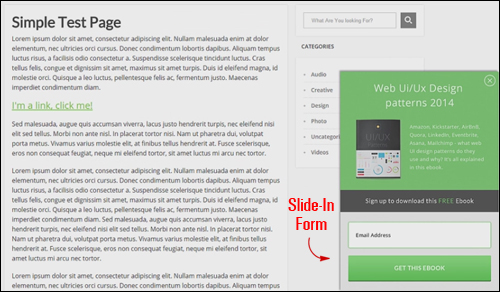
Display slide-in forms …
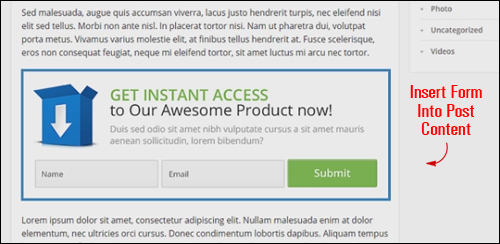
You can use Thrive Leads to place your opt-in forms anywhere inside your content, or the top of your blog posts …
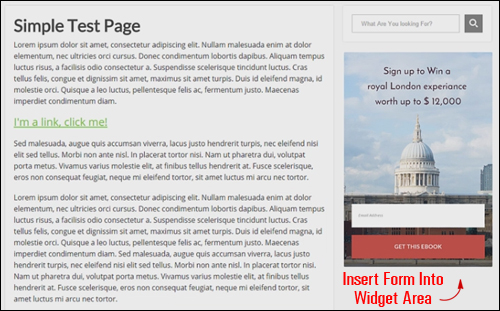
Insert an opt-in form into your sidebar navigation area …
You can insert two-step opt-in links that open a lightbox when a content link is clicked on …

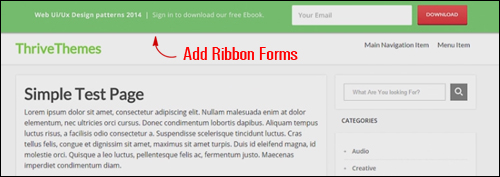
And even add ”sticky” ribbon forms to your site that display to visitors at the top of the screen and remain “sticky” as the visitor scrolls down your page …
As you can see, Thrive Leads integrates every kind of subscription form you need in one single plugin …
Thrive Leads also lets you add ‘smart’ Exit Popups that display opt-in forms with exit intent technology, which allow you to capture visitor details when they exit your site.
And it gets better …
Features
Thrive Leads offers many unique features to WP users. Here are just some:
Fast And Simple To Install
Be up and running in no time. As already mentioned, the plugin developer provides extensive training and tutorials, webinars, case studies, plus a responsive support team.
This tool not only combines every type of opt-in form your business needs into one single plugin, as you’ve just seen, but it also lets you run all your list-building campaigns without ever leaving your own dashboard.
Built-In List Building Strategies For Optimal Conversions
Thrive Leads integrates all of the list-building strategies you need to boost your conversions into one easy-to-use tool:
Design And Deploy
Thrive Leads comes with dozens of built-in professionally-designed and web optimized form templates that can be fully customized to suit your needs, without technical skills required.
Simple “point and click” technology and a drag-and-drop editor allows you to create, modify and customize your forms …
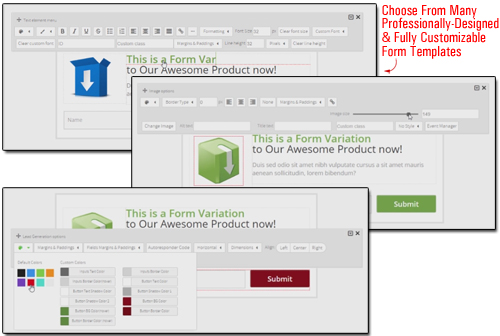
Powerful A/B Testing Engine
A/B testing is the fastest way to optimize your conversion rate and speed up the growth of your list.
Thrive Leads comes with a powerful A/B testing engine built-in that makes it easy to test a whole range of variables, including:
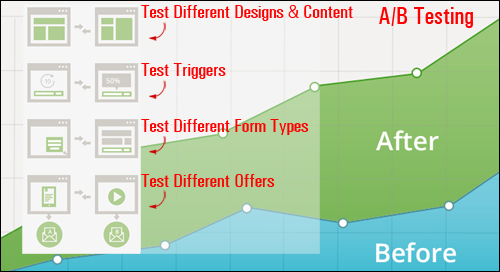
Split-Test Designs And Content
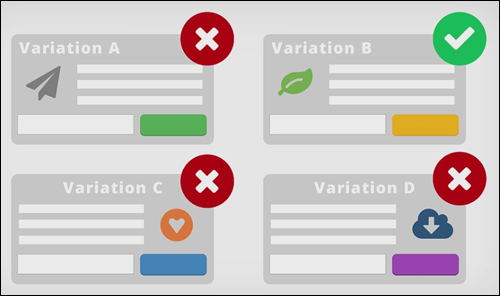
The plugin lets you test different designs and content, and provides an “automatic winner” feature that automatically eliminates the test variations that aren’t performing, and keep showing only the campaigns that are converting well after enough data has been collected.
You simply start your test and the plugin will handle everything else, automatically helping you increase your conversion rates over time.
Test Form Triggers

Thrive Leads lets you customize when and how your forms should display to visitors.
For example, you can set up:
- Time-based triggers to show a link on your screen after 15 seconds
- Scroll-depth triggers where a message appears only when your visitor scrolls down at least 50% of the web page
- Exit-intent triggers that detect when someone is about to leave your page and presents them with a pop-up form.
Furthermore, you can also test if the form should appear instantly, or animate into view (e.g. slide in). You can test many triggers against one another to further optimize your conversion rate.
Test Different Opt-In Form Types
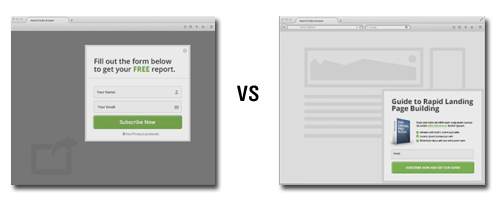
The Thrive Leads plugin also lets you perform split-tests against different form types. For example, you can test a lightbox pop-up vs an in-line form to see which type of form creates better results for your business.
Split-Test Entirely Different Offers
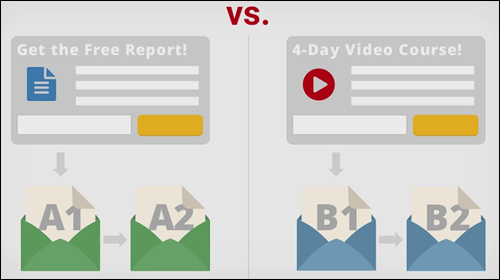
Thrive Leads even lets you test different offers against one another.
For example, you can assign different forms to different email marketing campaigns to help you determine which results in the best conversion rates for your business.
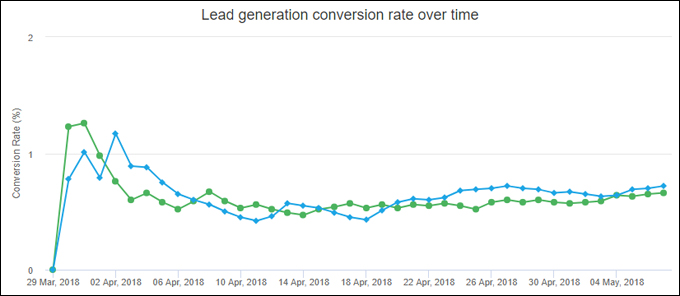
(Split-test different offers)
Not only does this plugin give you tremendous flexibility when it comes to split-testing your opt-in forms, but you can also easily clone an existing form – even make multiple copies, then modify the element(s) you want to test and instantly start running your A/B split test again, and all of this can be done in just a few minutes.
Additional features of the Thrive Leads plugin include:
Smart Targeting Features
You can create hyper-targeted offers for your visitors with 3 targeting options (Easy, Advanced, Ultimate). You are given granular control over how you target your offers to make your offers highly relevant.
For example, you can create a “catch-all” offer to show on all posts and pages or only your blog posts, or specify exactly where kinds of offers — even specific designs — will display across your entire site based on certain rules you set (e.g. a slide-in form on all Pages), including which templates, archive pages, etc. or, conversely, where to prevent forms from displaying on your site.
You can even create highly relevant offers to display to specific segments of your audience at exactly the right moment. Use this feature to create hyper-targeted and extremely profitable lists.
You can even use different lists with different services and different forms.
Advanced Lead Generation Forms Supported
Advanced form features supported include multiple fields, checkboxes, radio buttons & drop-down menus.
100% Mobile Responsive
Your forms and list marketing campaigns will show up correctly on any device or screen size.
The plugin has also been tested for compatibility will all major browsers.
Gain Actionable Insights
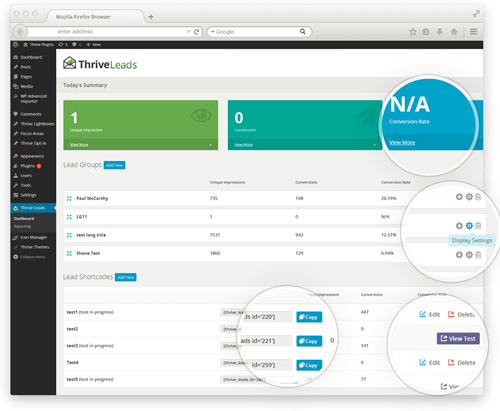
this plugin gives you access to detailed reports that let you see exactly how your opt-ins and A/B tests perform over time.
Additionally, the software provides a “lead sources” report that shows you exactly where your most valuable traffic is coming from, allowing you to plan your campaigns to get highly qualified traffic from your best converting sources.
Integrates Seamlessly With All Major Autoresponders And Leading Email Marketing Solutions
If your autoresponder allows embedding of HTML forms then Thrive Leads with work seamlessly with your solution.
Plus, you can use different lists and different services with different forms, so you’re not dependent on any one system.

As you can see, Thrive Leads gives you many opt-in testing capabilities that extend well beyond what most other list-building tools provide.
Testimonials
Here are just a few of the testimonials plugin users have submitted regarding Thrive Leads:
“Your stuff is beautifully designed, fast and has great options for marketers that you just don’t see with other themes. Great, great job! Absolutely love Thrive!” David Coleman
***
“I really look forward to more training from the Thrive Themes team. Love the product and want to get better!” Cristina Favreau
Support
As mentioned previously, ThriveThemes provides extensive tutorials, webinars and a support team that is available to provide you with any assistance you need.
Video tutorials explaining exactly what you’re seeing and how to use the plugin are provided throughout the plugin interface. You can also access an extensive knowledgebase of tutorials, training webinars, case studies and list building strategies, so you get a ton of help, training and support on how to get the most out of Thrive Leads.
The software is well-supported, and users get one-year software upgrades with their purchase, backed by a no-risk, 30 day, 100% money-back guarantee.
Software Cost
The plugin is available in the following editions:
- Single Site – The Single Site option lets you install & activate the plugin on a single domain. Includes all plugin features, plus Free, unlimited updates, with 1 year of support included. Cost = $49.00.
- Unlimited Sites Edition – The Unlimited Sites edition allows you to install & activate the plugin on all websites that you own and operate. All plugin features are included, plus Free, unlimited updates, with 1 year of support included. Price = $97.00.
- Agency Edition – The Agency license allows you to install & activate the plugin on unlimited domains that you own and operate, and on all of your client sites. All features are included, plus Free, unlimited updates, with 1 year of support included.. Cost = $199.00.
Note: Price details for Thrive Leads depends on whether there are any promotions or limited-time specials being offered. When we last checked, the plugin retails for the prices shown above. This may not be the actual pricing charged by the software seller when you visit the plugin site and there may be additional upsells or one-time offers after purchasing.
Check the plugin’s website for the current pricing here:
Additional Information
Even on an existing site with hundreds of posts, you can install the plugin and use the targeting feature to retroactively show the most relevant and higher-converting opt-in forms throughout your website.
For ”how-to” videos of the plugin in action, including help documentation and tutorials, FAQs, support helpdesk, contact details and more, visit the Thrive Leads website.
Our Recommendation
Building a list is absolutely essential for building a successful online business. When it comes to growing a email list, the only way to increase the speed your list grows is by running split-tests and find out what works best for your business. Thrive Leads makes a very powerful tool available to WordPress users without technical or cost barriers, such as requiring expert coding skills or ongoing subscriptions.
With Thrive Leads, you have complete control over exactly where and how your opt-in forms are shown to visitors, and the tools to increase your opt-in rates. There are other opt-in form plugins and solutions for list-building, but the main difference is that other list-building plugins are designed to focus more on functionality, such as enable users to create and add popups to their site. Thrive Leads starts with this type of functionality, but their real focus is on conversion optimization.
As Thrive Themes state on their website …
“It’s not just about helping you build your mailing list. It’s about helping you build your mailing list as fast as possible!”

To learn more, check out the plugin here: Thrive Leads – Mailing Builder For Conversion-Focused WP Users
By the way …
We use Thrive Leads here on WPCompendium.org. Check it out for yourself …
***