WordPress Traffic Automation Guide
 This tutorial is part of a comprehensive tutorial series aimed at helping you learn how to grow your business online using a WordPress-driven website or blog and proven marketing methods that are easy to use and easy to implement.
***
WordPress Traffic Automation Blueprint – Overview
 Just about every single business needs a constant stream of visitors to prosper online.
Learning how to drive visitors to your website is a requirement of running a successful business online. Lack of online traffic is also one of the most common complaints made by website owners everywhere.
Why Are So Many Businesses Struggling To Drive More Traffic To Their Websites?
If you type any of the phrases below into Google …
- “how to attract more traffic to your site”
- “how can I bring more visitors to my web site for free”
- “top 100 resources to bring more visitors”
- “ways to drive more web site traffic using StumbleUpon”
- “I need more free web traffic”
… and you will immediately find an overwhelming number of sites offering you tips, tricks, and information about different methods to get more traffic to your site …

(There are many methods to drive more website visitors. This article series will show you how to set up a simple system to benefit from many of these traffic generation methods!)
Clearly, there is no shortage of ways to drive more visitors to your web site. There are thousands of tutorials and free information that can show you methods to increase traffic to your web site.
The problem is often more about businesses not investing sufficient time into learning how to grow traffic sustainably, not setting up systems that allow them to manage the process effectively, and, in many cases, not even being aware that there are ways to configure your website to automate and leverage your web traffic generation.
The illustration below shows the typical approach many small businesses take when it comes to generating traffic to their sites …
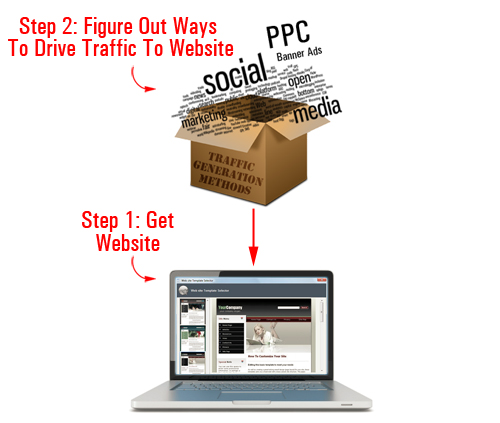
(This is how most small businesses approach the challenge of generating web traffic)
Essentially, the approach most small businesses typically take is this: first, you build your website, and then you figure out ways of driving traffic to it.
As you will discover in a moment, there is a better approach.

You shouldn’t make the mistake of thinking that ”outsourcing” your traffic generation to professionals will take care of this problem.
There is nothing wrong with outsourcing if you have great systems set up to manage your traffic generation activities. If not, all you will probably do is end up investing a lot of your time and money searching for a positive ROI traffic-getting strategy.
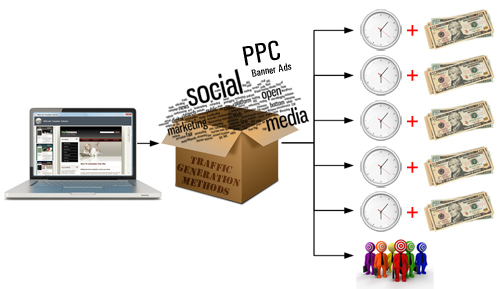
(Without a solid foundation and the right systems in place, web traffic generation can end up becoming a costly activity!)
Getting a continuous stream of web traffic sustainably involves setting up a solid foundation online, putting the right systems in place, continually testing campaign variables, experimenting with different marketing and promotional services, analyzing results, measuring ROI across different traffic generation opportunities, etc.
Is There A Way To Automate The Process Of Getting Website Traffic?
Imagine if all you had to do to drive new visitors to your website was to publish valuable content on a regular basis.
This is not fantasy or science fiction … it’s a fact! As a matter of fact, many website owners are already doing this … and so can you!
In this article series, you will learn the process of setting up an automated traffic machine that can instantly begin to attract web traffic to your site, simply by publishing regular content to your website.
How To Set Up A System That Will Automatically Help Drive Traffic To Your Site
As you can see in the diagram below, the web traffic method we present in this article series involves 3 fundamental steps:
- Set up systems to lay down a solid foundation for creating sustainable traffic
- Add content on a regular basis to drive visitors and generate data organically
- Add new traffic strategies and test
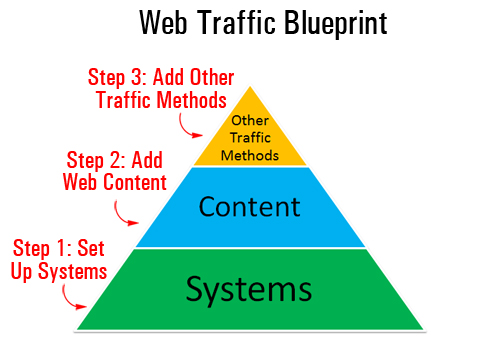
(To get sustainable web traffic, you first need to set up the right systems)
Right now, we’re mostly concerned with Step 1. The purpose of this article series is to show you how to set up a traffic generation system that will ultimately help you:
- Save time using leverage and automation
- Save money by starting simple and scaling up to suit your budget
- Automatically get your web content indexed faster in search engines
- Instantly share your content to all of your social media accounts (e.g. Facebook, Twitter, Pinterest, etc.)
- Gain valuable insights about your traffic generation strategies, analyze results, measure ROI, etc.
- Outsource traffic generation while maintaining full control of the process
- Grow your business online cost-effectively and sustainably
You can achieve all of the above using what we will refer to throughout our article series as an “expertly configured” WordPress website or blog …
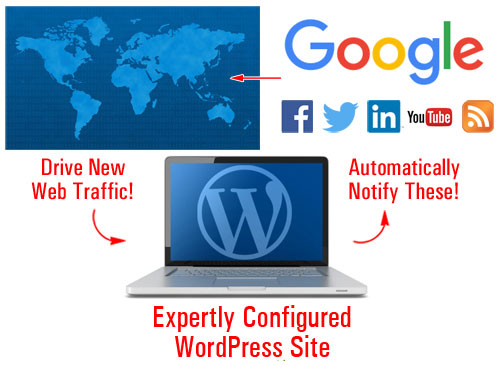
(With an expertly configured WordPress web site, you just publish new content and your website will then do the rest, notifying other sites about your new content and bringing you back traffic!)
An Expertly Configured WordPress Site – What Is It?
An expertly configured WordPress web site is not the same thing as a professionally-configured WordPress website.
An expertly configured WordPress website or blog is a blog that is not only driven by WordPress, but has also been expertly set up and configured (either by yourself or professionally) to take advantage of the enormous power, features and functionality of WordPress and how it can be integrated with other sites, specifically in areas like search engine optimization, 3rd-party site syndication, and reporting.
Why Use An Expertly Configured WordPress-Powered Web Site?
We have published many comprehensive articles on this site about why you should use WordPress-powered websites the WordPress CMS to grow your business online.
Understanding how and why an “expertly configured” WordPress blog will help drive web traffic to your business requires a number of article installments, which is why we highly recommend that you spend some time reading our other articles and consider subscribing to our site (this way, you will be informed whenever we publish new content about this topic).
Let’s start by addressing these basic questions:
Why use WordPress to set up an automated traffic generation system? What does WordPress provide that other web platforms don’t?
Take a look at the diagram below …
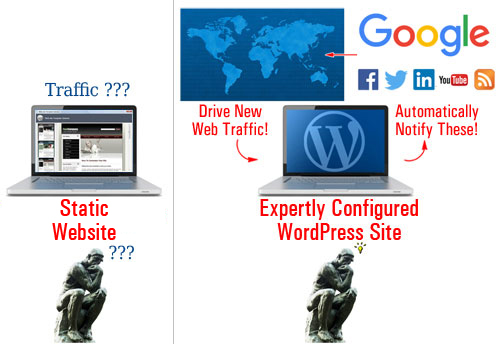
(Static vs Expertly Configured WordPress Website)
Many sites are built on applications that create websites with “static” web pages. Essentially, what this means is that the web content just sits inside the server waiting to be found. A static website doesn’t communicate with anyone outside the application; it doesn’t ’ping’ anybody in cyberspace or inform any other website that new content has been published to your website.
Think about it … if in a static website, all of the content simply sits in a server passively waiting to be found, then the web site owner has to actively keep promoting their website and its content to keep driving web traffic.
WordPress is different!
WordPress comes with powerful built-in functionality that gives users the ability to set up, configure and build an automated “online traffic generation” machine, where all you then have to do is publish new content and your site will do the rest, immediately notifying search engines, social media and other online properties about your site to automatically generate you new web site visitors …
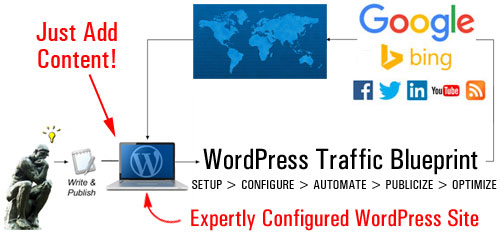
(With an expertly configured WordPress web site, you just post new content and your website will then do the rest, informing other sites about your new content and bringing you back web traffic!)
An Automated Content Distribution, Traffic And Lead Generation, And Sales & Marketing System
With an expertly configured WordPress site, you can build more than just a website for your business … you can set up an automated traffic and lead generation and sales & marketing system, where all you do is publish your content and WordPress then automates the rest …
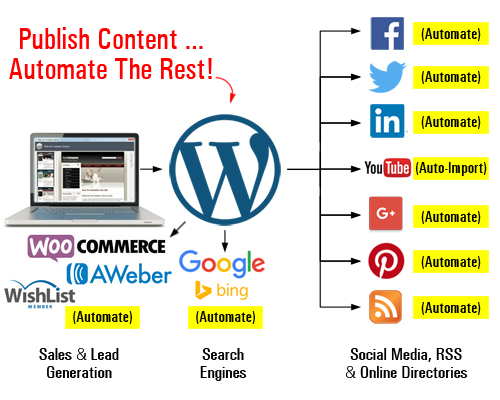
(Set up an automated content distribution, lead and traffic generation, and sales and marketing system with WordPress)
As your business evolves, you can add more functionality and automate processes like:
- Sell products and services with e-commerce,
- Capture leads with opt-in forms and add your subscribers to newsletters and autoresponders,
- Allow visitors to register on your site with different membership levels,
- And so much more!
You can do all of this using inexpensive WordPress plugins. Once these plugins are installed and configured on your site, just direct your visitors to the appropriate sections (e.g. your store, subscription forms, membership area, etc.)
The video below shows you what an expertly configured WordPress site can do for your business …
In Part 2 of The Website Traffic Blueprint overview, we break down the components of this automated traffic machine:
- Setup – Learn the best way to start if you don’t have a web presence yet, or if you already have an existing site that may or may not have been built using WordPress.
- Configure – By default, WordPress already comes with a number of built-in features and settings that can help you generate traffic. Learn what features and settings need to be configured for optimal benefit.
- Automate – Your traffic system requires not only internal WordPress settings to be expertly configured but also an integration of your WordPress site with third-party tools and other web properties (e.g. webmaster, analytics, and social media accounts).
- Publicize – After your WordPress site has been configured and integrated with various external sites, all you have to do is publish new content consistently and WordPress will immediately notify and inform search engines, your social media sites and other online properties about the new content, giving your site wider online exposure to new visitors.
- Optimize – We recommend starting with a content-based strategy to build sustainable traffic. With the right systems in place, you can also begin monitoring and understanding incoming traffic and gather valuable data that will allow you to make more intelligent and cost-effective decisions as you expand to additional traffic generation methods.

This is the end of Section One
To read more, click on the link below:
This article is part of a comprehensive article series aimed at helping small business owners learn how to grow their business online cost-effectively using a WordPress-powered website or blog and proven web marketing strategies.
Would You Like To Get Automatically Notified When New Tutorials Get Published? Then Subscribe Using The Form Below!
***
"Wow! I never knew there's so much to learn about WordPress! I bought one of the WordPress for Dummies three years ago, such authors need to be on this course!" - Rich Law, Create A Blog Now