Grow Your Accounting Business Online With WordPress
 The online economy has not only revolutionised businesses around the world, it has also created significant challenges and opportunities for the accounting and financial services sector.
Online Challenges For Accountants
Certified Public Accountants today must work harder than ever before to remain competitive. Not only do they have to be fully involved in the communities and industries they serve, they must also develop an active presence online. This includes having a dynamic website and searching for better ways to grow your business services online.
As well as spending dollars in offline marketing activities, you will probably find (if you haven’t already) that in order to compete, increasingly larger amounts of their budget need to be directed towards developing and managing a website that brings new prospects, engages visitors, outperforms the competition in search engines and helps to increase your presence online.
This means that your site not only has to look professional, your pages have to be fast-loading, and your website layout has to be easy to navigate, but even more importantly, your site’s needs will change in time and sections will need to be updated often. This requires the implementation of a well-developed web and content management strategy.
Another difficult challenge that accounting firms (and most businesses) face, is that your site has only about thirty seconds to provide users with what they need or they will find what they are looking for elsewhere.
“Websites have evolved into central information hubs where service information is still present but enhanced with web portals, hyperlinks to state and federal sites, and a variety of free tools.”
Michael Alter, http://www.accountingweb.com/technology/accounting-software/tips-for-improving-your-website
Online Opportunities For CPAs
As well as facing significant business and technology changes, there are also many online opportunities available for accounting companies that are willing to evolve to meet the demands of the digital economy and think strategically about improving their online business marketing skills.
In this article, you will discover new ways to find new potential clients and establish online credibility for your accounting or financial services business.

As well as providing tips and information on cost-effective ways to improve your website, we also recommend that you consider using WordPress to power your accounting or financial services website.
For more information about the benefits and advantages of using the WordPress Content Management System, see the articles below:
- Why A Poorly Built Website Can Lose You Money
- An Online Guide To Building Your Successful Small Business Using A WordPress Blog
Ways To Improve Your Accounting Website
We’ll start first by reviewing some basics. In this section, we’ll look at ways to improve your website and get better results online. We will look at what pages you need, what content works best for accounting websites, ways to improve layout and navigation structure, etc.
If you need additional information about website planning, visit this page: A Comprehensive Guide To Web Site Planning For Business Owners
Improve Your Website Pages
All business websites need some basic web pages. Let’s go over the pages your need and how to set up your accounting or financial services website for best results.
Your Services And Products
You need a page that describes your products or services.
Your page will include services such as:
- Business accounting – business planning, company formation, general accounting, payroll, preparing financial statements, bookkeeping, financing, budgeting, forecasting, strategic planning, consulting, etc.
- Taxation – preparing, planning, reviewing, auditing, advice, problem resolution
- Investment strategies
- Corporate accounting
- Wealth creation
- Superannuation/retirement plan (401k) advice
- Audit risk assessment and assurance
- Quickbooks – setup, training, tune up, and support
- Specialist services – mergers, acquisitions, information technology, secretarial, rentals, trusts, fiduciary accounting, succession planning, selling a business, transfers, etc.
- Lending and leasing
List all of the services you provide, not just the ones you specialize in. Educate your visitors about the benefits of using your services and direct them to your contact or appointment booking page.
About Us
The ‘About Us’ page needs to describe your business and what your business stands for, its unique approach, supported community programs, etc.
It’s important to also list any industry awards, accreditations, recognitions, certifications, associations, publications, etc., that can be used to promote your company and position it above the competition.

(List all of your professional awards accreditations, certifications, recognitions, publications, associations, etc. in your About Us page. Image sourced from: deloitte.com)
Our Team
If you are looking for quicker, easier and cost-effective ways to sell more products or services online, then help prospective clients get to know your organization better.
Prospects need to relate to your business. One great way to do that is to have a page that introduces your employees. It should include a photo and a mini biography. Since most visitors are probably not well-versed in accounting terms your bio descriptions should tell who they are and what their specialties are. It should also explain what those specialties mean. This page should also include social buttons so your prospective clients can follow your staff members on their social pages.
On this page, don’t be afraid to show the human side of your team members with personal stories, hobbies, etc., but make sure to outline your employee’s qualifications, why they are an asset to your team, and more importantly, how they will help add value to your clients’ business.

(Make sure to add a page that introduces your employees to prospective new clients. Image source: deepsky.com)
We have written a detailed tutorial on how to easily add a simple and easy-to-manage list directory of staff members to WordPress using a free WordPress plugin here: How To Easily Add A Simple Employee List On Your WordPress Site Without Editing Code
Job Opportunities Page
List any career opportunities within your firm. It should include training provided, employee benefits, advancement opportunities, etc. You can also include stories of recruits who have established a solid career path thanks to your firm and information such as the job outlook and career opportunities in the accounting industry.
Maintain a positions available section in your page. If there are no positions currently available, consider inviting people to return periodically to this page, subscribe to your updates list, follow your social pages, etc.
Case Studies
Case studies and testimonials are a great way to show potential clients what kind of accounting solutions you are capable of implementing to help solve their problems. By adding a page with testimonials from previous clients and case studies, you are also helping to establish social proof.
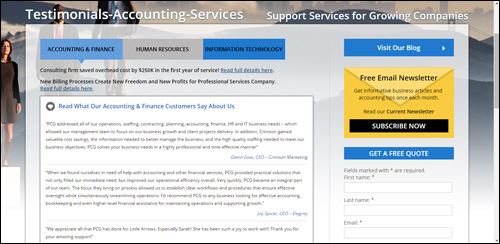
(Add a page with client reviews and case studies. Image sourced from: pcg-services.com)
If you want to learn more about using testimonials, case studies and user reviews, refer to this article: Improve Your Conversions With Meaningful Customer Testimonials
Contact Us
Having a contact page is absolutely necessary.
Your contact page should provide visitors with some or all of the following:
- Name
- Physical location
- Phone
- Facsimile
- Email address
- Google Map and directions
- Web URL
- Contact form
- Contact name
- Social media URLs
- Interactive chat (optional feature)
If your business services different areas you will want to make this clear when showing the address and contact info.
Consider also including a few links for the most commonly asked questions, frequently-visited pages, special offers, helpdesk, newsletter, blog, etc.
Blog
A blog is a powerful marketing tool for your business. Blogs are built around a content management system that allows you to promote your business by publishing timely content like company news, company updates, training information, opinions on current topics, videos, media presentations, etc.
If you already have an existing website, then consider adding a WordPress-driven blog to promote your firm.
If you don’t have a website yet, or your existing website is very hard to keep updated with new content or not delivering you the results you want, then WordPress can become both your website and blog.

You may not know this, but WordPress can turn into an automated traffic-generation system that can help begin delivering web traffic to your website, simply by publishing regular content to your web site.
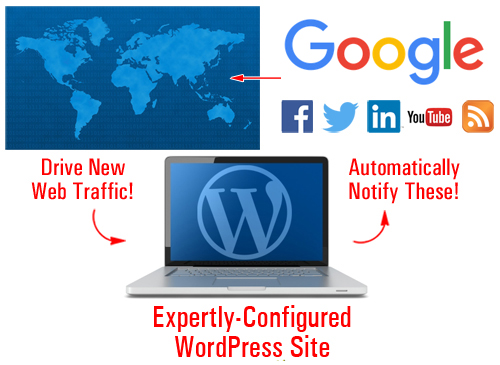
(WordPress can drive web traffic automatically to your site)
Go here to learn more about this: Web Site Traffic Blueprint – A Complete Guide To Attracting More Web Visitors For Your Business Automatically
Legal Information
Having a website that complies will all legal requirements online is vital, not just for building credibility with prospective clients, but also to ensure that you are not contravening any laws and regulations wherever you provide services to.
Adding the following legal pages to your accounting website will help you stay out of legal hot water with most regulatory authorities, third-party service providers (e.g. Google), and other potential legal threats or inconveniences:
- Contact Page
- Privacy Statement
- Terms Of Use
- Website Disclaimer
- Affiliate Agreement
- Anti-Spam Policy
- Compensation Disclosure
- DMCA Notice
- Earnings Disclaimer
- External Links Policy
- Financial Disclaimers
- Refund Policy
- Video/Audio Terms
- and others
We have written a detailed article on adding legal pages to your website. Go here to learn more about this: Adding Legal Pages To Your Website
Improve Your Web Content
In today’s globally competitive economy, the sooner you begin to engage in the practice of content marketing, the sooner you will begin to see results and differentiate yourself from the competition.
You want to provide great content with advice and tips that will get your readers to share your content and come back for more. Publishing content is a great way to inform and teach site visitors and prospects about your business and about doing business with your organization.
For example, for an accounting business, topics can cover:
- Explanations of balance sheets
- Profit and loss statements
- Duties and legal responsibilities of company directors
- How to present accounts for fundraising activities
- Cashflow planning tips
- Maximizing business insurance cover
- Protecting revenues
- How to structure a self-managed retirement fund
- Do’s and don’ts of … (e.g. purchasing insurance, claiming business expenses, etc.)
You can also create a series of informative articles that will help your your readers gain a better understanding of your services, such as finance accounting, business accounting, using office accounting software, reducing debt, understanding accounting conventions, etc.
Remember to include the same keywords and terminology in your articles that your readers would search for.
We recommend subscribing to our Content Marketing Email Training Series. You will receive regular training emails with easy-to-digest information that will teach exactly how to drive more traffic to your website or blog, save money creating high-quality content that will add value to your visitors and grow your business online using content marketing strategies. It’s not only a great course with loads of useful information, it’s also completely FREE!
Ways To Improve Visitor Experience
Improving your website’s user experience (generally referred to as UX) helps keep visitors coming back and using your site. This section will show you different ways to improve visitor engagement and user experience.
Use RSS Feeds
An RSS feed provides many benefits for your business.
If you provide valuable information, other sites may want to syndicate your content to their visitors.
Some of the benefits of syndicating your content to other businesses using RSS feeds, include:
- All of your content updates are kept in one place
- your content distribution doesn’t rely on email
- Feeds can be shared
- Users can subscribe to your feed
- It provides a way for links to point back to your content
- RSS feeds can be submitted to RSS directories and aggregator services
- RSS provides several ways for your readers to receive your content (e.g. subscribers can view your content on their mobile device using different applications)
- RSS is built into WordPress
There are also benefits to providing valuable information on your website from other sites, such as the fact that you don’t have to write, manage or update the content.
You can find many useful RSS feeds for your website by searching online for relevant government departments and well-known industry bodies.
Below we have listed examples of useful RSS feeds you could consider adding to your website:
- Taxation Policy Center: http://www.taxpolicycenter.org/press/rss.cfm
- Australian Taxation Office: https://www.ato.gov.au/RSS-news-feeds.aspx
- Canada Revenue Agency: http://www.cra-arc.gc.ca/rssfeeds/
- UK HM Revenue and Customs: http://www.hmrc.gov.uk/rss/rss.htm
- South Africa Revenue Service: http://www.sars.gov.za/Pages/RSS-Feeds.aspx
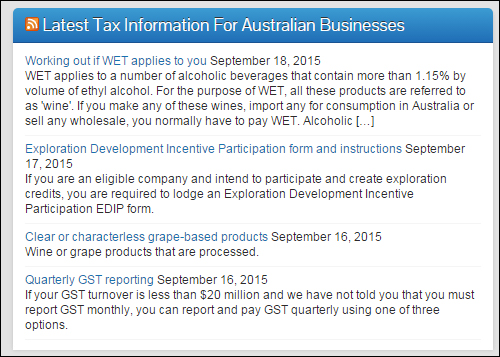
(Use RSS (Really Simple Syndication) feeds to provide your visitors with a better user experience.)
Provide Checklists
Adding checklists and forms to your site is a great way to help increase visitor engagement, add value to your audience and set yourself apart from the competition. They can give them useful step-by-step instructions and resources to perform a task. They are also great business planning tools.
Forms and checklists can include subjects such as:
- How To Set Up A Company
- Rental Property Checklist
- Not-For-Profit Governance Checklist
- Disclosure Requirements
- Sole Trader Tax Checklist
- Capital Gains Tax Checklist
- Income Tax Variation Forms
Unique Tools
Providing unique tools and applications for businesses (or links to these tools) is a great way to increase visitor engagement and significantly add value to users. Calculators, such as loan and tax calculators, are great tools you can add to accounting websites. Others can include time cards, and retirement and interest calculators.
In the next section of this guide, we take a look at a number of online tools you can use in your accounting site using WordPress plugins that can help improve seo, improve user engagement and generate more traffic to your business.

***
This is the end of section 1.
To continue, click here:

Subscribe To WPCompendium.org And Get Notified When New Tutorials Get Published!
***
***
"I was absolutely amazed at the scope and breadth of these tutorials! The most in-depth training I have ever received on any subject!" - Myke O'Neill, DailyGreenPost.com
***