 In Part One of our Web Site Traffic Blueprint article series overview, we explained that the key to turning your website into an automated web traffic generation machine is to use an “expertly configured” WordPress website.
As we also explained, an expertly configured WordPress website is not the same as a professionally-configured WordPress website. An expertly configured WordPress site is a site that is not only powered by the WordPress CMS, but has also been expertly set up and configured (either by yourself or professionally) to take advantage of the enormous power, features and functionality of WordPress and the way it can be integrated with other services, specifically in areas like SEO, content syndication and reporting.
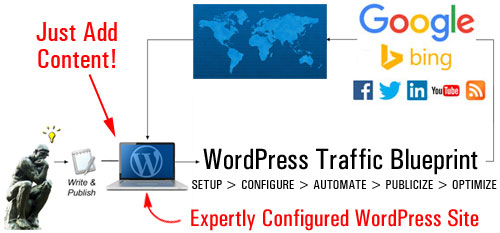
(With an expertly configured WordPress web site, all you have to do is add great content on a regular basis to automatically drive traffic!)
Once your WordPress site has been expertly configured and fully set up, all you then need to do is publish content on a regular basis to automatically bring web traffic organically.
As outlined in Part 1 of this article series, the components of this automated traffic system are as follows:
- Setup
- Configure
- Automate
- Optimize
In this article, we look at the “Setup” phase of the automation process. You will learn the best way to start if you don’t have a web presence yet, or if you already have an existing site that may or may not have been built using WordPress.
WordPress Web Traffic Automation Blueprint – Setup
If You Don’t Have A Website
If you haven’t got a web presence yet, it’s quite simple … build a WordPress website!
WordPress is the most powerful, flexible, cost-effective and the easiest to use content management system on the planet. We provide loads of articles, tips, and tutorials about the benefits and advantages of using WordPress to grow your business online.
For example, to see just how popular WordPress has become, see this article: WordPress: Facts And Statistics
After choosing to build your site with WordPress, the next step is to choose which type of WordPress platform you will use to build your web presence on.
This step is important because there are 2 types of WordPress platforms available …
WordPress – Self-Hosted vs Hosted
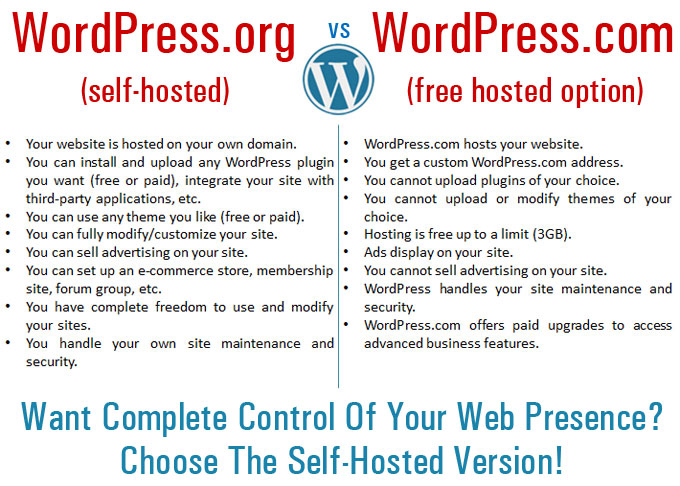
(WordPress.org Or WordPress.com?)
WordPress offers users a ”hosted” and a “self-hosted” option.
WordPress.org allows you to download the full-featured WordPress CMS application for free and host a WordPress site or blog under your own domain name. This is the “self-hosted” WordPress option.
In the “hosted option”, WordPress hosts your blog for free at WordPress.com. There are, however, some limitations to what you can and can’t do with your blog when it is hosted for free at WordPress.com.
If you plan to build a professional business presence online and you want to set up the traffic system described here, then choose the “self-hosted” WordPress platform. The benefits of choosing the “self-hosted” option (WordPress.org) far outweigh those of hosting a free site at WordPress.com. You can fully customize your web presence and avoid the limitations of the hosted option. Keep in mind that you can overcome the limitations of the free hosting platform by upgrading to a paid option, but then why not just start off with a WordPress site hosted on your domain and avoid the hassles of upgrading later?
If You Already Have An Existing Site
If you already have an existing site, first, check if the website has been built using WordPress.
If you need help with this step, check this article: The Easy Way To Tell If Your Blog Runs On WordPress
If your existing site is powered by WordPress, move to the next step, and make sure that your site’s internal settings have been properly configured. We cover this step in more detail in another tutorial.
If your existing website was built using something other than WordPress software, you have some decisions to make.
Take a look at the diagram below …
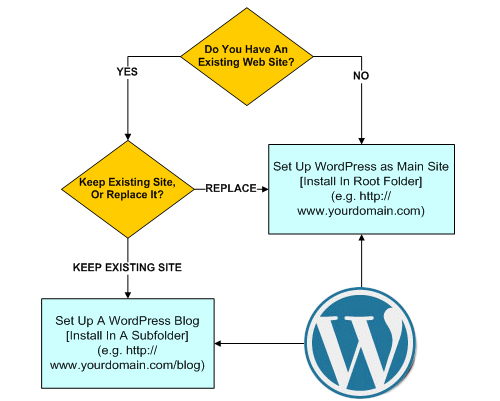
(Use the above flowchart to decide how to set up a WordPress website or blog on your domain)
Basically, you have two choices:
- Replace your existing website so that your main website is built with WordPress, or
- Keep your existing website and add a WordPress blog. This blog will then be used to drive traffic to your main web site.

If you choose to keep your existing web site and add a WordPress-driven blog, make sure to use the self-hosted version of WordPress, which requires a domain name and webhosting, but allows you to fully configure your blog’s settings and customize the design and style of your existing site using a suitable theme for WordPress.
To use WordPress as your main site, install it in the “root” folder of your domain (i.e. www.mydomainname.com).
If you already have a website, then you will want to install WordPress in a subfolder of your domain, e.g. www.mydomainname.com/blog (you can name the subdirectory anything you want).
If you already have a site that you don’t want to delete or replace with a WordPress site, the other option you have is to set up your WordPress site or blog on an entirely different domain.
This way:
- mydomainname.com – goes to your existing website
- myotherdomain.com – goes to your WordPress site
Once you have set up your WordPress site, the next step is to configure its internal settings. This step is covered in the next article in the WordPress Traffic Blueprint series.

This is the end of Section Two
To read the rest of this article, click here:

This article is part of an tutorial series designed to help website owners learn how to grow their business online cost-effectively with a WordPress-driven website and proven online marketing methods.
Would You Like To Get Automatically Notified When New Tutorials Are Published? Then Subscribe To WPCompendium.org!
***
"Your training is the best in the world! It is simple, yet detailed, direct, understandable, memorable, and complete." Andrea Adams, FinancialJourney.org
***