Grow Your Medical Or Healthcare Business Online With WordPress
 The digital information age has not only revolutionised business globally, it has also created new challenges and great opportunities for medical businesses.
Online Challenges For The Health Profession
Now, more than ever, businesses in the medical industry must work harder than ever to remain competitive. Not only do you have to be fully involved in the community you serve, you must also develop a strong digital presence. This includes having an effective website and learning smarter ways to market your practice online.
In addition to spending money in offline marketing, businesses in the medical-related industry are also finding that they need to invest a greater share of their marketing budget towards the development and maintenance of a website that attracts clients, engages users, outperforms the competition in search engines and helps them gain a wider marketing exposure online.
This means that your website not only has to look great, load fast, and your website layout has to be easy to navigate, but even more importantly, the needs of the website will change over time and sections may need to be updated often. This requires implementing well-developed web and content management strategy.
One other problem that health-related organizations face online, as other businesses do for that matter, is that you have only around thirty seconds to help users find the information they are searching for or they will leave the site and go elsewhere.
“Websites have evolved into central information hubs where service information is still present but enhanced with web portals, hyperlinks to state and federal sites, and a variety of free tools.”
Michael Alter, http://www.accountingweb.com/technology/accounting-software/tips-for-improving-your-website
Online Opportunities For Health And Medical Services Providers
As well as facing significant challenges, there are also loads of online opportunities available to businesses in the health or medical-related profession that can adapt to meet the demands of the digital economy and can think progressively in terms of improving their online marketing skills.
In this comprehensive guide, you will learn ways and opportunities to find new bookings and create noticeable improvements in your online results.

As well as providing tips and information on ways to improve your web presence, we also emphasize the benefits and advantages of using the WordPress Content Management System (CMS) to power your health-related website or blog.
To learn more about the benefits and advantages of using the WordPress Content Management System, see the articles below:
- Learn Why A Poorly Constructed Website Can Cost You Money
- Learn How To Grow Your Small Business With WordPress
Practical Tips For Improving Your Health Practice Services Website
This section covers how to improve your website and get better results online. We will look at what pages your website needs, what content you need, navigation structure, etc.
If you need assistance or help planning your website, read this detailed guide: The Website Planning Process Explained - A Money-Saving Guide For Business Owners
Basic Pages
All websites need several basic web pages. Let’s review these.
Description Of Services
You need a page that explains your services and any products that you offer. Depending on which area of health or medical services you specialize in, this page could list services such as:
- Medical And Surgical – e.g. anaesthetics, nephrology blood disorders, cancer, gerontology, renal, infection control, eye diseases surgical outpatients, etc.
- Dental Services – e.g. cosmetic dentistry, holistic dentistry, bad breath treatment, restorations, dentofacial orthopedics, emergency dental services, etc.
- Cardiology – e.g. cardiac surgery, coronary care
- Prenatal and Neonatal – e.g. birth suites, midwifery, etc.
- Child Health – paediatrics, child development, children services, etc.
- Diagnostic services – breast screens, skin cancer, radiology, gynaecology, MRI scanning, food allergy testing, etc.
- Pathology – laboratory testing and analysis, routine pathology testing, occupational and environmental testing, speech pathology, etc
- Counselling services – mental health, alcohol, tobacco & other drug counselling, trauma counselling, wellbeing, social work services
- Alternative treatments – acupuncture, reflexology, hydrotherapy, massage therapy, osteopathy, hypnotherapy, etc.
- Other medical services/therapies – weight management, sports medicine, lymphedema therapy, stomal therapy, neurosciences, artificial limbs, mobility, home and community care, sexual health, medical supplies, etc.
List all of the services you provide. Provide your visitors with information that will educate them about what these services do and direct them to your appointment booking page.
About Us
This page should give a description of your business and what it stands for, its unique approach, philanthropy, etc.
This page should also mention any professional awards, recognitions, accreditations, certifications, associations, publications, etc., that can be used to promote your business and to position yourself above the competition.

(List all of your awards accreditations, recognitions, certifications, publications, associations, etc. in your About page. Image sourced from: squaremedical.com.au)
Your Staff
Are you looking for cost-effective ways to sell more products or services online and increase user interaction with your site? Then help prospective clients get to know, like and trust your organization better.
You want prospects to relate to your business. One great way to do that is to have a page that introduces your people. This page should include a photo and a brief biography. Since most visitors are probably not very well-versed in health or medical-related terms it should tell who they are and what their specialties are. You may also want to explain what those specialized areas do. It should include social buttons that will allow your visitors to follow selected team members on their social networks.
On this page, don’t be afraid to show the human side of your team members with personal stories, hobbies, etc., but make sure to outline your employee’s expertise, why they are an asset to your team, and more importantly, how they will help add value to your clients’ business.
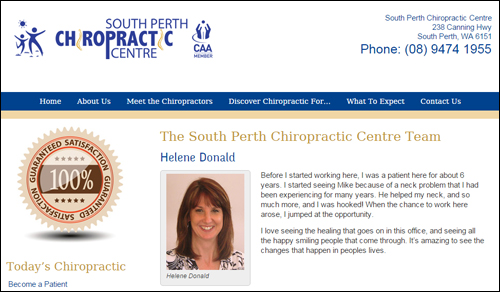
(Add a page that introduces your team members to prospective new clients. Screenshot source: southperthchiro.com.au)
To learn more about how to easily add an easy-to-update list of staff members to your web site without editing code, refer to this step-by-step tutorial: Step-By-Step Tutorial: Adding A Staff Directory
Recruitment Page
List any job or career opportunities within your company. This page would include type of training provided, benefits, advancement opportunities, social activities promoted by your business, etc. You can include information about additional career opportunities in the medical industry.
Also include a positions available section in your page. If there are no positions currently available, consider inviting people to return periodically to this page, join your newsletter, follow you on social media, etc.
Testimonials
Case studies and testimonials are a great way to attract potential clients and showcase your services. By adding a page with case studies and reviews from clients, you will also help to provide visitors social proof online for your business.
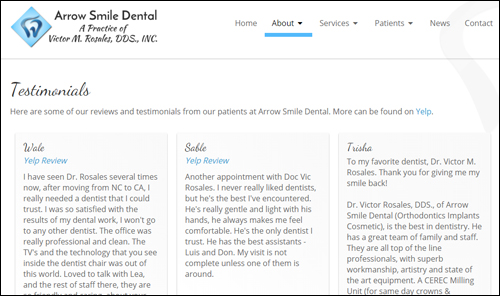
(Add a page to your site with case studies and reviews from clients. Screenshot image sourced from: arrowsmiledental.com)
If you want to learn more about using case studies, testimonials and user reviews, see this article: How To Turn More Visitors Into Prospects With Powerful Testimonials
Contact Us
Having a contact page is essential.
Your contact page should include some or all of the following information:
- Business Name
- Your physical location
- Phone
- Facsimile
- Map
- Website URL
- Contact form
- Request for more information – who to contact
- Links to social media profiles
- Online chat (optional)
If you operate from different areas you will want to make this clear when displaying your address and contact info.
You can also include links pointing to the most commonly asked questions page, frequently-visited pages, booking request, support area, newsletter, blog, etc.
Add A Medical Or Health-Related Blog Section
A blog is a powerful marketing tool for your business. Blogs typically include a content management system that is simple to use and allows you to easily promote your business by publishing timely content like the latest announcements, product releases, training articles and tutorials, opinions on current topics, educational videos, infographics, etc.
If you already have an existing website, then consider adding a WordPress-powered blog to market your medical practice.
If you don’t have a website yet, or if your existing website is very hard to manage or not giving you the results you want, then WordPress can serve both as your website and business blog.

Something few people know about, is that an expertly configured WordPress site can turn your web presence into an automated traffic machine that will help begin delivering targeted traffic to your site, simply by publishing new content to your website on a consistent basis.
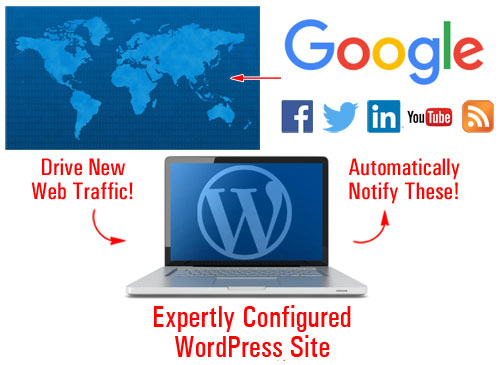
(WordPress can drive new traffic automatically to your site)
Go here to learn more:
Legal Info Pages
It’s important for professional companies to make sure they have a compliant website. This is not only important for establishing credibility with prospective clients, but also to ensure that no local, regional or federal laws or regulations are being broken wherever you provide services.
Adding some or all of the legal pages below to your medical or health website will help keep you out of trouble with most regulatory authorities, third-party service providers, and other potential legal threats and inconveniences:
- Contact Page
- Privacy Policy
- Terms And Conditions Of Use
- Website Disclaimer
- Affiliate Agreement
- Anti-Spam Policy
- Compensation Disclosure
- DMCA Notice
- Earnings Disclaimer
- External Linking Policy
- Health and Financial Disclaimers
- Refund Policy
- Video/Audio Terms
- etc.
We have written a comprehensive article on adding legal pages to your website here: Why You Need To Add Legal Pages To Your Website
Improving The Content On Your Website
In today’s globally competitive economy, the sooner you begin to publish good content on your site, the sooner you will begin to see results and differentiate yourself from other competitors.
Providing useful content with great advice, information and tips will get your visitors sharing it with others and coming back for more. Content marketing is the most effective way to educate site visitors and prospects about your business and services.
For example, if your business provides weight loss services, then some of the topics you can cover as content on your site:
- Nutrients your body needs on a daily basis (protein, carbs, vitamins, fats, minerals)
- How to calculate how many calories you burn each day
- Comparing different diets, e.g. Paleo diet, Raw Food diet, Jenny Craig diet (what these are, how they can benefit you, how effective they are)
- What processed foods can derail your weight loss program (and healthier choices)
- Etc.
You can also create a series of informative articles that will help your your readers understand your medical or health-related services, by explaining benefits, procedures, terminology, etc.
Include keywords in your content that your prospective clients would search for online.
We recommend subscribing to our Content Marketing Email Training Series. You will receive a comprehensive series of training emails with actionable information that will show you how to drive more traffic to your web site, save money creating useful content for your site visitors and grow your business online using content marketing. It’s not only a great course with loads of useful information, it’s also 100% FREE!
Ways Of Improving Visitor Engagement And User Experience
Improving your website’s user experience (generally referred to as UX) helps to keep visitors coming back and engaging with your site. This section will show you different ways to improve visitor engagement and UX.
Add RSS Feeds
RSS (Really Simple Syndication) feeds can help to improve your visitor engagement and user experience in several ways.
If you provide valuable content, other sites will want to syndicate your content to their visitors.
Some of the benefits of syndicating your content to other websites using RSS feeds, include:
- All of your content updates are in one place
- Doesn’t rely on email
- Can be shared and picked up by other sites online
- Users can subscribe to your feed
- It provides links back to your content
- RSS feeds can be submitted to RSS directories and aggregators
- There are various ways your readers can receive your content (e.g. subscribers can read your content on their mobile device using a feed reader)
- It’s built into WordPress
There are also a number of benefits when it comes to adding syndicated content to your website from other sites, such as the fact that you don’t have to write, manage or update the content.
You can find RSS feeds with useful content for your website by searching online for health-related government departments or industry bodies.
For example, here are some feeds you could consider adding to your site:
- US Department Of Health And Human Services – e.g. Blog RSS feed: http://feeds.feedburner.com/SelectedHhsBlogPosts, etc. You can also choose individual feeds, like feeds on women’s health issues (e.g. Emergency preparedness, Environmental health, Illnesses and disabilities, Mental health, Violence against women, etc.) here: http://womenshealth.gov/news/rss/rss-feeds.html
- US National Libraries Of Medicine – For a directory of feeds from well-known medical journals, publications and websites (e.g. BioMed Central, The Journal of General Physiology (JGP), BMJ Medical Humanities, The AAPS Journal (American Association of Pharmaceutical Scientists), American Institute of Biological Sciences, etc.) go here: http://www.healthplusplus.com/wiki/List_of_RSS_feeds_on_health
- National Institutes Of Health (www.nih.gov) - Get many health-related feeds here: http://www.nih.gov/Subscriptions.htm
- US Food And Drug Administration (FDA) – Find FDA-related RSS feeds (e.g. enforcement reports, health fraud, product recalls, tobacco news, etc.) and podcasts here: http://www.fda.gov/AboutFDA/ContactFDA/StayInformed/RSSFeeds
- UK Department Of Health (https://www.gov.uk/government/organisations/department-of-health) – Latest news: https://www.gov.uk/government/organisations/department-of-health.atom
- The Department Of Health (Australian Government): http://www.health.gov.au/internet/main/publishing.nsf/xml/rssLatestNews.xml
- Department Of Public Health (Australia – State Level): e.g. NSW – http://www.health.nsw.gov.au/pages/rss.aspx
- Centers For Disease Control And Prevention - Get many health-related RSS feeds and podcasts here: http://www2c.cdc.gov/podcasts/rss.asp
- Medical News Feeds: You can search medical news RSS feeds in places like the NYTimes RSS feeds section (e.g. Research: http://www.nytimes.com/services/xml/rss/nyt/Research.xml)
- MedicineNet.com – MedTerms Medical Word of the Day: http://www.medicinenet.com/rss/dailyword.xml. You can also choose specific feeds here (http://www.medicinenet.com/rss/article.htm) (e.g. Alzheimer’s Disease, Arthritis, Chronic Pain, Diabetes, Sexual Health, Thyroid, etc.)
- Medical News Today – MNT Featured Headlines: http://rss.medicalnewstoday.com/featurednews.xml
- Medical News Today – You can also choose individual RSS feeds here: http://www.medicalnewstoday.com/newsfeeds-rss (e.g. Lung Cancer, Arthritis/Rheumatology, Fibromyalgia, Autism, Bones/Orthopedics, Allergy, Personal Monitoring/Wearable Technology, etc.)
You can also just search online for general RSS feeds, e.g. “medical rss feeds” or search for feeds on specific areas, e.g. “anxiety rss feeds”, “general practice rss feeds”, “restless legs syndrome rss feeds”, etc.
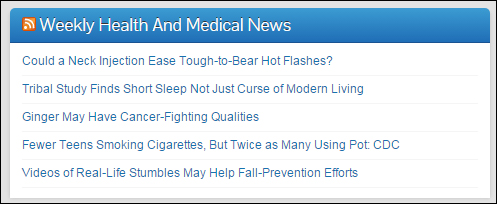
(RSS (Really Simple Syndication) feeds can help to improve your site’s user experience.)
Checklists & Charts
Checklists and medical forms are a great way to help increase visitor engagement, add value to your audience and set yourself apart from the competition. They can provide users with useful information and resources to complete tasks. Forms and checklists can also be great educational tools.
You can provide checklists and forms (or links to these) covering a range of areas such as:
- Booking appointments
- Checklists for post-surgery recovery
- Health checklists for specific medical conditions
- Dental checklists – e.g. first visit, oral maintenance program, general dentistry, etc.
- Fitness and exercise program checklists and charts
- General charts & infographics (e.g. caloric level of different foods, the importance of sleep at different stages of development, etc.)
Adding Online Tools
Providing unique tools, gadgets and applications on your website can help increase visitor engagement and significantly add value to your visitors. Health-related calculators are some of the most popular tools for your website. Other applications would include things like diagnostic tools, and even recipes.
In the next section of this guide, we will be discussing a number of WordPress plugins you can use in your website that can also help to improve your search engine optimization, improve user engagement and drive more visitors to your business.

***
This is the end of part 1 of this comprehensive article on ways to build your medical business web presence.
To view the rest of this guide, click this link:
***
***
"Wow! I never knew there's so much to learn about WordPress! I bought one of the WordPress for Dummies three years ago, such authors need to be on this course!" - Rich Law, Create A Blog Now