WordPress Traffic Automation Guide
 This tutorial is part of a comprehensive series of articles and tutorials designed to help you learn how to grow your business online cost-effectively and drive traffic automatically with a WordPress website or blog and proven marketing strategies that are easy to use and quick to implement.
***
WordPress Traffic Automation Blueprint – Overview
 Web traffic is the lifeblood of most businesses online.
Discovering effective ways to get more traffic to your website is one of the most important skills of building an online presence successfully. Lack of online visitors is also one of the most common complaints made by website owners everywhere.
Why Are So Many Businesses Struggling To Drive More Visitors To Their Web Sites?
Type any of the phrases below into Google …
- “how to get traffic to my web site for free”
- “increase web traffic to my web site for free”
- “ideas to drive more website traffic”
- “learn how to increase more web traffic using Pinterest”
- “I need web visitors”
… and you will find tons of pages offering you information about methods to increase visitors to your website …

(There are lots of methods to increase your website visitors. This article series will show you how to set up a system to take advantage of most of these traffic generation strategies!)
There is clearly no shortage of ways to drive more traffic to your website. There are thousands of tutorials and free sites that can teach you cost-effective methods to drive more visitors to your website.
The problem often has more to do with business owners not investing enough time into learning how to generate new web traffic sustainably, not setting up systems to manage the traffic generation process effectively, and, in many cases, not even being aware that there are ways to automate and leverage your web traffic generation.
The illustration below shows the typical approach many small businesses take when it comes to generating web traffic …
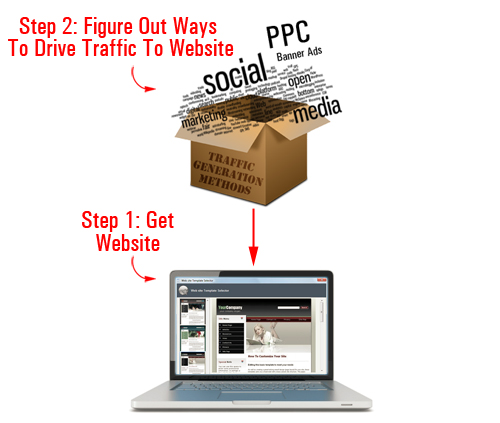
(This is how many site owners approach the challenge of generating web traffic)
Essentially, the typical approach most businesses take is this: first, you get a website, and then you figure out ways of driving traffic to your site.
As you will see in a moment, there is a smarter approach.

Don’t make the mistake of believing that “outsourcing” your traffic generation will take care of this problem.
There is nothing wrong with outsourcing if you have great systems set up to manage and process information about your traffic generation activities already. If not, all you will probably do is end up investing a lot of valuable time and money looking for a winning traffic-getting method.
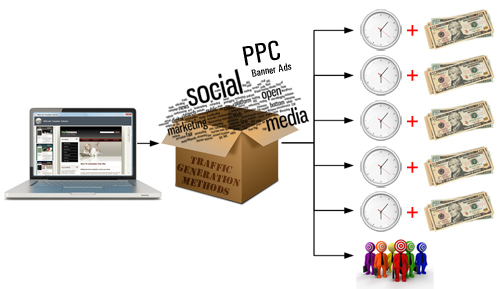
(Without a solid foundation and proper systems, website traffic generation can become very costly!)
Getting a regular stream of web traffic sustainably requires setting up a solid foundation online, putting proper systems in place, testing campaign variables, experimenting with different advertising and promotional services, tracking results, measuring ROI across different traffic generation methods, etc.
Is There A Way To Automate The Process Of Getting Traffic?
Imagine owning a website where the only thing you had to do to deliver an ongoing stream of web traffic to your business was to regularly publish great content to your website.
This is not science fiction or fantasy … it’s a fact! Many website owners are profiting with what we’ve described above … and so can you!
In this article series, you will learn what you need to do to set up an automated traffic generation system that can begin attracting new targeted traffic to your web site, simply by publishing regular content to your site.
How To Set Up An Automated Traffic System
As you can see in the diagram below, the web traffic method we discuss in this article series involves three basic steps:
- Set up specific systems to lay down a solid foundation for creating sustainable traffic
- Add content on a regular basis to drive visitors and generate data organically
- Test new traffic methods
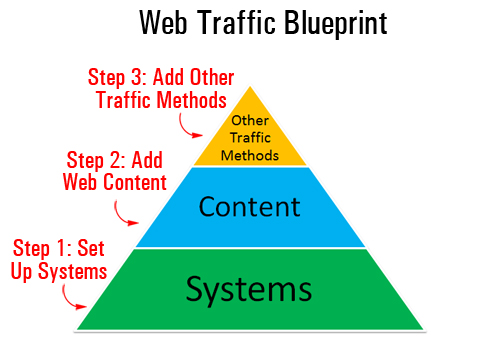
(To generate sustainable traffic, you need to first set up the right systems)
At this stage, we’ll mostly be focusing on Step One. The aim of this article series is to lay the foundations of a traffic generation system that will ultimately:
- Save time using automation and leverage
- Save money in lots of different ways
- Automatically notify search engines
- Instantly notify and publicize your content to all of your social media accounts (e.g. Facebook, Twitter, LinkedIn, etc.)
- Gain valuable insights about your traffic generation strategies, analyze results, measure ROI, etc.
- Outsource traffic generation while maintaining full control of the process
- Grow your business online cost-effectively and sustainably
All of the above can be achieved using what we will refer to throughout our article series as an “expertly configured” WordPress website or blog …
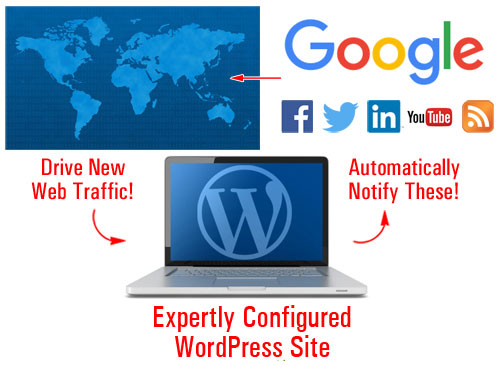
(With an expertly configured WordPress site, you just add content and your website then does the rest, informing other sites about your new content and bringing you back web traffic!)
An Expertly Configured WordPress Website – What Is It?
An expertly configured WordPress web site is not the same thing as a professionally-configured WordPress website.
An ”expertly configured” WordPress website or blog is a website that is not only driven by WordPress, but has also been expertly set up and configured (either by yourself or professionally) to take full advantage of the enormous power, ease-of-use and functionality of WordPress and its integration with various sites, specifically in areas like search engine optimization, content syndication, and analytics.
Why Do I Need An Expertly Configured WordPress-Driven Web Site?
We provide a number of excellent blog posts on this site about the benefits of using WordPress-powered web sites to grow your business online.
Understanding why and how an “expertly configured” WordPress website can help create an automated traffic generation system requires several article installments, which is why we really recommend that you spend some time reading our other articles and subscribe to this site (this way, we can let you know whenever new information on this topic is published).
Let’s begin by answering a couple of basic questions:
Why do you need to use WordPress to set up an automated traffic generation system? What does WordPress do that other web platforms don’t?
Take a look at the diagram below …
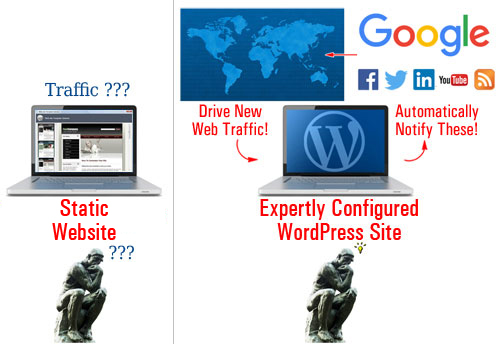
(Static Website vs Expertly Configured WordPress Site)
Many web sites are built on applications that create websites with “static” web pages. Essentially, this means that your content just sits inside a server waiting to be discovered. A static website doesn’t communicate with anything else outside its application; it doesn’t send out ’pings’ to anyone in cyberspace or notify any other website that new content has recently been added to your site.
Think about it … if with a traditional website, your content simply sits there passively waiting to be found, then you have to actively keep promoting your web presence and your content to maintain web traffic coming.
WordPress is different!
The WordPress application provides special features that give users the ability to set up, configure and build an automated “traffic generation” machine, where all you then need to do is post new content and WordPress does the rest, immediately notifying search engines, social media and other online properties about your site to automatically bring you more website traffic …
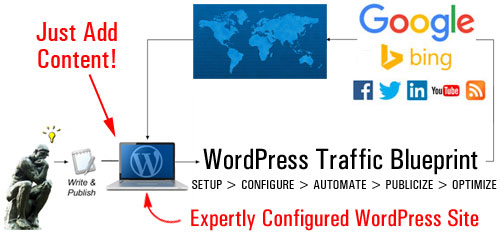
(With an expertly configured WordPress web site, you simply publish new content and your site then does the rest!)
An Automated Content Distribution, Traffic And Lead Generation, And Sales & Marketing System
With an expertly configured WordPress site, you can build more than just a website for your business … you can set up an automated traffic and lead generation and sales & marketing system, where all you do is publish your content and WordPress then automates the rest …
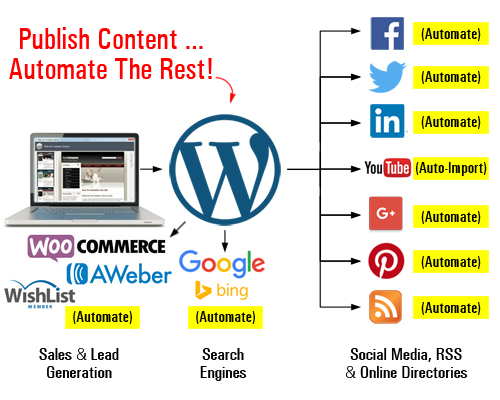
(Set up an automated content distribution, lead and traffic generation, and sales and marketing system with WordPress)
As your business evolves, you can add more functionality and automate processes like:
- Sell products and services with e-commerce,
- Capture leads with opt-in forms and add your subscribers to newsletters and autoresponders,
- Allow visitors to register on your site with different membership levels,
- And so much more!
You can do all of this using inexpensive WordPress plugins. Once these plugins are installed and configured on your site, just direct your visitors to the appropriate sections (e.g. your store, subscription forms, membership area, etc.)
The video below shows you what an expertly configured WordPress site can do for your business …
In Part 2 of The Web Site Traffic Blueprint overview, we break down the components of your automated web traffic machine:
- Setup – Learn the best way to start if you don’t have a web presence yet, or if you already have an existing site that may or may not have been built using WordPress.
- Configure – WordPress already comes with a number of built-in features and settings to help you generate traffic. Learn what features and settings need to be configured for best results.
- Automate – Your traffic machine requires not only internal WordPress settings to be configured but also an expert integration of your WordPress site with third-party services and other web properties (e.g. webmaster, analytics, and social media accounts).
- Publicize – After configuring your WordPress settings and integrating your site with various external services, all you have to do is publish new content regularly and WordPress will instantly notify and inform search engines, your social media pages and other online properties about the new content, giving your site wider online exposure to potential visitors.
- Optimize – We recommend beginning with a content-focused strategy to build organic traffic. With the right systems in place, you can start tracking and analyzing incoming traffic and gather valuable data that will allow you to make intelligent and cost-effective decisions as you expand to other traffic generation methods.

This is the end of Part 1
To read more, click on the link below:
This article is part of a comprehensive article series designed to help you learn how to grow your business using a WordPress-powered website or blog and proven online marketing strategies.
Get Notified When New WordPress Tutorials Are Published – Subscribe Using The Form Below!
***
"These tutorials have so much information and are easy to understand. If you use WordPress or plan to in the future these will help you with everything you need to know." - Valisa (Mesa, Arizona)